Last updated: November 19, 2026
Quick Answer: An apartment holding deposit is refundable when the landlord causes the breakdown, the written agreement says it is refundable, or the landlord changes the deal after taking it. If you were asked to reserve an apartment with a holding deposit, the key question is not “Did I pay it?” but “What did the written agreement say, and who caused the move-in to fail?”
Key Takeaways
- A holding deposit reserves an apartment while screening finishes and the lease is being prepared.
- The signed agreement matters more than the receipt label.
- Usually, the side that caused the failed move-in determines whether the money comes back.
- A refund request should start in writing, with the agreement attached, not by phone.
What a holding deposit is meant to do

A holding deposit is money paid to reserve an apartment while the landlord finishes screening and prepares the rental agreement. It usually takes the unit off the market for a short period, often tied to a lease application or an “application hold” window of a few days to a couple of weeks.
That short window matters because the deposit is not the same thing as rent or a security deposit. Its job is to hold the apartment, not to cover normal wear, unpaid rent, or damage. The agreement may also call it a reservation deposit, which is a hint that the money is buying time and exclusivity, not a finished lease.
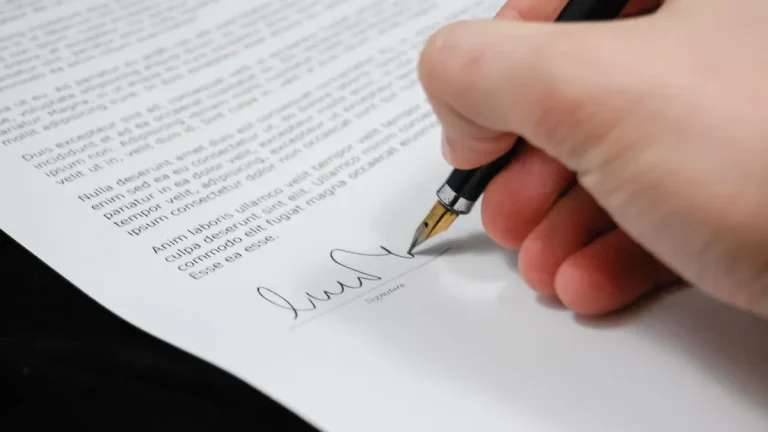
The important part is the paper trail. A written agreement should say:
- the amount paid
- how long the apartment will be held
- what has to happen before move-in
- when the deposit is returned
- when the landlord may keep it
Without those terms, a refund fight turns into a blame fight. With them, the answer usually comes down to one question: did the landlord or the tenant cause the deal to collapse during the holding period?
This is the part of the move-in process that sits between screening and the rental agreement. If the application is still pending, the landlord has not yet promised a lease, and the tenant has not yet taken possession. That makes the holding deposit a conditional payment, not a final one.
When is an apartment holding deposit refundable?
A holding deposit is refundable when the lease application is not approved for reasons outside the tenant’s control, the landlord backs out, or the landlord does not honor the written terms of the hold. That is the basic rule to use first.
A refund is most likely when:
- the landlord rejects the application after collecting the hold
- the landlord changes the rent, fee structure, move-in date, or lease terms after the hold is paid
- the landlord gives the apartment to someone else while the hold is still active
- the written agreement says the money is refundable if approval does not happen
- the tenant withdraws because the landlord failed to provide required paperwork or disclosures promised in the agreement
The common thread is fault. If the move-in falls through because the landlord did not follow the agreement, the deposit should usually come back. If the landlord simply decides not to rent to you after taking the money, keeping the deposit is hard to justify unless the agreement clearly says otherwise.
The opposite situation is different. If you change your mind after the landlord has held the apartment in your name and stopped showing it, the landlord may have a stronger argument for keeping some or all of the deposit, especially if the written agreement says the money is nonrefundable after approval or after a set deadline.
A clean way to think about it: refundable usually means the apartment did not get delivered because the landlord failed, the application was denied, or the written conditions were not met. Nonrefundable usually means the tenant walked away after the hold period or violated the terms that kept the apartment reserved.
If you need the larger context of screening costs and move-in charges, the hub page on rental application screening and move-in costs should sit next to this one.
Read the written agreement before you assume the money is lost

The written agreement controls more than the label on the receipt. A line that says “holding deposit,” “reservation deposit,” or “application hold” can mean very different things depending on the words that follow.
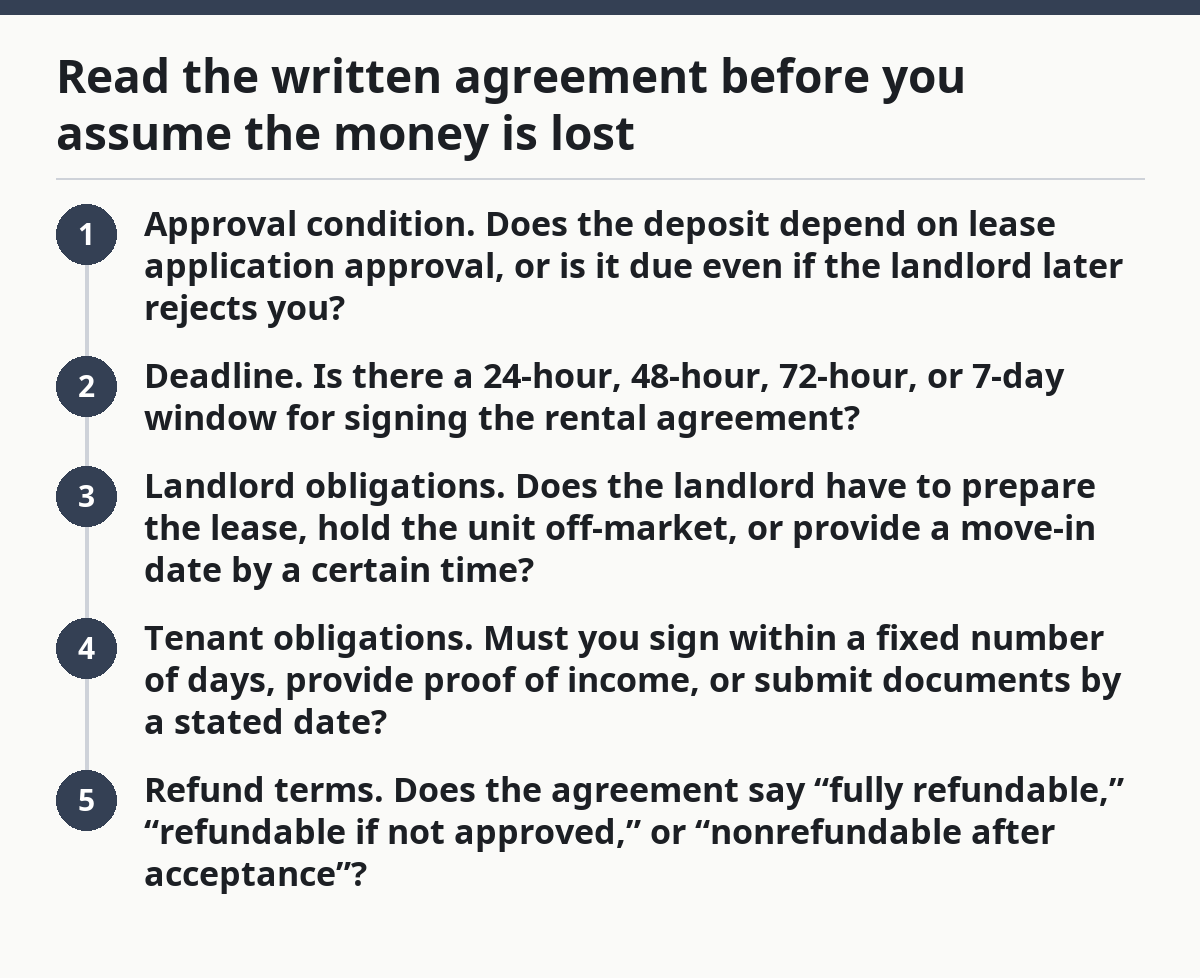
Check these 5 points in the document:
- Approval condition. Does the deposit depend on lease application approval, or is it due even if the landlord later rejects you?
- Deadline. Is there a 24-hour, 48-hour, 72-hour, or 7-day window for signing the rental agreement?
- Landlord obligations. Does the landlord have to prepare the lease, hold the unit off-market, or provide a move-in date by a certain time?
- Tenant obligations. Must you sign within a fixed number of days, provide proof of income, or submit documents by a stated date?
- Refund terms. Does the agreement say “fully refundable,” “refundable if not approved,” or “nonrefundable after acceptance”?
A missing deadline is a warning sign. If the agreement never says when the lease must be signed, the landlord may try to argue that any delay is your fault. If it does name a date, that date is the anchor.
Do not rely on a verbal promise from a leasing agent if the paper says something else. A text message may help show what was promised, but the signed document usually carries more weight.
So, the safest reading is to keep it narrow unless the paper clearly says otherwise. If the document gives you a refund only when a specific condition is not met, that condition has to happen exactly as written. If the document says the deposit is nonrefundable after approval, the landlord can usually keep it once the application clears and the apartment is reserved for you.
Who caused the move-in to fall through?
The party who caused the breakdown usually decides whether the holding deposit comes back. That is the simplest rule, and it is the one most people miss when they focus only on whether they “paid a deposit.”
If the landlord caused the failure, the deposit is more likely refundable. Examples include:
- the landlord approved you and then rented the apartment to someone else
- the landlord raised the rent after you paid the hold
- the rental agreement offered is different from what was promised
- the landlord misses the promised lease-signing date or move-in date
- the unit is no longer available because of the landlord’s error
If the tenant caused the failure, the deposit is more likely forfeited. Examples include:
- you stop responding during the hold period
- you refuse to sign the agreed rental agreement without a valid reason tied to the written terms
- you miss a deadline for documents that the lease application required
- you back out after the landlord has held the apartment off the market
There is a middle case, and it causes the most arguments. If the application is denied for reasons the landlord knew about at the start, or the landlord accepted the hold while leaving out a required condition, the refund question gets stronger. The paper trail matters here.
The practical test is simple: ask what changed between the day you paid and the day the deal died. If the landlord changed the terms or failed to deliver the reserved unit, the deposit should not disappear by default. If you changed your mind after the hold took effect, the landlord may have a stronger claim to keep it.
How to get a holding deposit refunded
A holding deposit refund usually starts with a written request and a copy of the agreement, not with a phone call. The goal is to show the landlord the exact clause that makes the money refundable and the exact event that triggered it.
Follow this sequence:
- Gather the lease application, the holding deposit receipt, and the rental agreement in one place. You need the amount, the date paid, and the refund language all together.
- Mark the deadline or condition that failed. Use the specific date or number in the agreement, such as 3 days to sign or 7 days to provide documents, so the landlord can see the missed step.
- Write a short refund demand. State the apartment address, the amount paid, the date paid, and why the deposit should be returned under the written terms.
- Attach proof of the failure. That may be a rejection notice, a landlord text about changed terms, or a message showing the unit was given to someone else.
- Set a reasonable response time. Seven calendar days is a common, clear window to request action without sounding vague.
- Keep the request in writing. Email provides a timestamp and a copy of the exchange.
The best outcome is often a refund by check, card reversal, or transfer, depending on how the money was originally paid. If the landlord refuses, the next step depends on the amount and your local rules, but the first move should still be a paper request that tracks the contract.
A bare-bones message is enough if it is precise:
“On [date], I paid a $[amount] holding deposit for [address]. Under the written agreement, the deposit is refundable if [condition]. That condition was not met because [reason]. Please return the deposit within 7 days.”
Do not bury the request in a long argument. The goal is to make it easy to say yes.
Common mistakes that cost tenants their refund
The biggest mistake is assuming every holding deposit is automatically refundable. It is not. If the agreement says the deposit becomes nonrefundable after approval or after 48 hours, and you sign that paper, the landlord will point to that clause when you ask for the money back.
Another mistake is treating an application hold like a guaranteed lease. It is not a finished rental agreement. A landlord can reserve an apartment during screening without promising final approval. If you move as if the lease is already signed, you can lose bargaining power fast.
A third mistake is relying on vague texts instead of the signed document. A friendly message saying “We should be able to refund it” is weaker than a written clause saying “refundable if not approved.” When the two conflict, the signed agreement usually matters more.
A fourth mistake is waiting too long. If the apartment is re-rented and 2 or 3 weeks pass before you object, the landlord has more room to argue that you accepted the outcome. A prompt written request keeps the issue tied to the original hold period.
The fix is boring but effective: read the refund clause before paying, keep every message, and ask for the rental agreement in writing. If the landlord will not put the terms on paper, that is itself a warning sign.
What to do if the deposit is called “nonrefundable”
A “nonrefundable” label does not automatically make every refusal to refund valid, but it does make your case narrower. If the agreement clearly says the holding deposit is nonrefundable after a certain event, the landlord may keep it if that event happened exactly as stated.
That said, the label alone is not the whole story. A nonrefundable deposit is still vulnerable if:
- the landlord never held the apartment as promised
- the landlord rejected the application for a reason not disclosed in the written terms
- the landlord changed the rental agreement after taking the money
- the landlord gave the unit to someone else during the hold period
- the clause is vague enough that no one can tell when nonrefundability starts
If you are deciding whether to pay, this is the point to slow down. A 10-minute read of the clause can save a 10-day argument later.
This is also where a hard judgment matters: if the agreement clearly says “nonrefundable after approval,” and approval happened, you should not assume a refund is coming. That position is weak. The better use of your time is to check whether the landlord actually met the conditions in the agreement and whether the wording is specific enough to stand up on its own.
The holding deposit is refundable when the deal fails because the landlord failed, the application is denied, or the written terms say it is. It is much less likely to be refundable when you walk away after the apartment was properly held for you.
Is a holding deposit the same as a security deposit?
No, a holding deposit is not the same as a security deposit. A holding deposit reserves the apartment during the lease application process, while a security deposit is tied to move-in and damage or unpaid rent under the lease. The two are often handled differently in the written agreement, and the refund rules are not the same. See also the CFPB for general guidance on rental deposits and fees.
Can a landlord keep a holding deposit if they reject my application?
Usually, no if the rejection happened under a refundable hold agreement and the landlord caused the deal to fail. A landlord may have a better claim to keep it if the paper clearly says the deposit is nonrefundable or if the tenant failed to meet the stated application conditions. The written terms control. For state-level rules, check the legal aid resources in your state and the FTC’s guidance on avoiding housing scams.
Should a holding deposit be in writing?
Yes, a holding deposit should be in writing. A written agreement should state the amount, the hold period, the refund conditions, and the deadline for signing the rental agreement. Without that, the dispute turns into a memory contest, and the landlord usually has the stronger paper trail. In practice, the written clause is the best evidence of what both sides agreed to.
Drafted with AI; not yet reviewed by a person.