Last updated: November 19, 2026
Repair requests and habitability action — The Complete Guide explains how to turn a broken heater into a documented repair case by sending a dated repair request by certified mail with return receipt requested, then tracking what the landlord does next. In Texas, the repair deadline is 7 days, though the severity of the problem and the availability of materials and labor can change that, according to the Texas State Law Library. For additional guidance on tenant notices, see the Texas Office of the Attorney General.
What counts as the first real step?
The first real step is a written repair request that can be proved later. A phone call may feel faster, but it is easy to lose and hard to show a timeline from memory, which matters when the issue is a broken heater in winter.
Use this order:
- Write down the problem, the date, and the room or unit affected. Check that the note names the heater and the habitability issue, not just “it’s cold.”
- Send a dated repair request by certified mail with return receipt requested, or by registered mail, as the Texas Office of the Attorney General says. Check that the mailing shows the date sent and gives you proof of delivery. Do not hand it over without keeping a copy.
- Keep the request short and clear. Check that it asks for the specific repair, not a list of unrelated complaints. Do not add threats in the first letter.
- Save a copy of the exact letter and the mailing receipt. Check that both show the same address and date. Do not throw away the envelope or receipt.
- Mark the calendar the day the request goes out. Check the next 7 days as a working timeline under Texas law, while remembering that severity and availability of materials or labor can change the practical timing. Do not assume silence means the landlord never got it.
- If the landlord responds, write down what was promised and when. Check whether a real repair date is given. Do not treat vague promises as the full plan.
A good repair request looks plain and dated. A weak request looks like a complaint buried in a long text chain with no mailing proof. The mailing method matters because it creates the paper trail that later shows notice, delay, and whether any diligent repair effort happened at all.
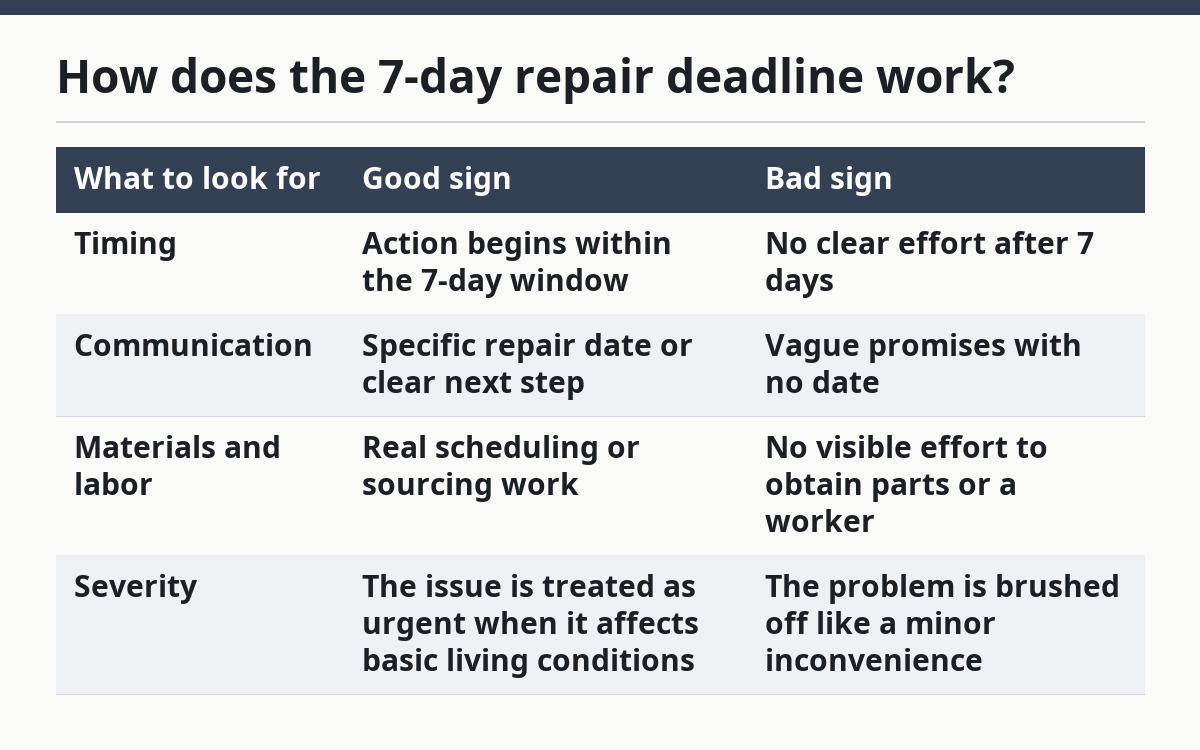
How does the 7-day repair deadline work?
The 7-day deadline is the starting point, not the whole story. According to the Texas State Law Library, Texas law defines the repair deadline as 7 days, but the severity of the problem and the availability of materials and labor can change that.
That means a reader should treat 7 days as the first checkpoint, then ask two practical questions: how serious is the loss, and what has the landlord actually done during that time? A heater that fails in winter is not the same as a loose cabinet hinge. The more the problem affects safe daily use, the more urgent the repair looks; if the facts are unclear, consult a Texas housing attorney or another qualified professional before acting on the deadline alone.
Here is a simple way to measure the difference between a good response and a bad one, but consult a qualified professional if the facts are unclear or the repair issue is serious:
| What to look for | Good sign | Bad sign |
|---|---|---|
| Timing | Action begins within the 7-day window | No clear effort after 7 days |
| Communication | Specific repair date or clear next step | Vague promises with no date |
| Materials and labor | Real scheduling or sourcing work | No visible effort to obtain parts or a worker |
| Severity | The issue is treated as urgent when it affects basic living conditions | The problem is brushed off like a minor inconvenience |
The mistake many tenants make is treating the 7 days as a magic switch. It is better to treat it as a timeline marker, and if the issue is serious, consult a qualified professional about the next step. If the heater still fails after that point and no diligent effort appears, the record matters more than anger.
What should the repair request say?
The repair request should say what is broken, when you reported it, and that you want it fixed now. A short letter works better than a long story because it gives the landlord one job and one timeline. For a sample of how Texas explains tenant repair notice, review the Texas Office of the Attorney General and the Texas State Law Library repair guide.
Use this structure:
- Start with the date at the top. Check that the date is current and matches the mailing date. Do not backdate the letter.
- Name the problem in one sentence. Check that it says “broken heater” or the exact item that failed. Do not bury the point in a paragraph of complaints.
- Describe the effect on the home. Check that the note explains the living condition problem plainly. Do not turn it into a speech.
- State that the request is for repair. Check that the request is direct, not implied. Do not ask for a favor as if the issue were optional.
- Mail it by certified mail with return receipt requested, or by registered mail, as the Texas Office of the Attorney General says. Check that you keep proof of mailing. Do not use a method you cannot later prove.
- Save a copy in a folder with the envelope, receipt, and any reply. Check that all papers stay in one place. Do not rely on a phone gallery full of unlabeled photos alone.
- Write the next follow-up date on the calendar. Check the 7-day mark under Texas law and note whether the landlord has made a real repair effort. Do not wait without a plan.
The strongest request is specific without being dramatic. The wrong request tries to win the argument before it starts. A dated letter with postal proof is much more useful than a tense conversation with no record.
| Piece of proof | Why it matters | What can go wrong if it is missing |
|---|---|---|
| Dated request | Shows when notice was given | No clear start date |
| Certified or registered mailing proof | Shows the request was sent in a trackable way | Landlord can deny or blur notice |
| Return receipt | Helps show delivery | Timing becomes harder to prove |
| Copy of the letter | Shows exactly what was asked for | The wording can be disputed later |
A repair request is not a place for legal jargon unless it is needed. Plain language is better because it is easier to read, easier to save, and easier to quote later.
What does a landlord’s real repair effort look like?
A real repair effort looks like action, not just talk. After the certified notice, the Texas Office of the Attorney General says further action may follow if the landlord still has not made diligent repair efforts within a reasonable time.
That phrase matters because “diligent” is not the same as “mentioned once.” A landlord who schedules a repair, orders parts, or sends a worker is acting differently from a landlord who says “we’re looking into it” and leaves the heater broken. The point is to separate motion from progress.
Use this checklist:
- Ask for the repair date in writing. Check whether the answer names a day or a time window. Do not accept a reply that stays vague for another week.
- Ask what step is next. Check whether parts, labor, or access to the unit has been arranged. Do not assume a promise means materials are already on hand.
- Keep a log of each contact. Check the date, time, and who spoke. Do not keep the log only in memory.
- Compare the response to the 7-day timeline. Check whether the landlord is moving inside that window or has gone past it without action. Do not confuse a polite answer with repair work.
- Notice whether the problem is being treated as urgent. Check whether the heater is still unusable or only partly working. Do not minimize a condition that still affects daily living.
- Save every message. Check that texts, emails, and letters all stay together. Do not delete old messages once someone says “we’ll handle it.”
The visual test is simple: a real repair effort leaves marks on paper and on the schedule. You can point to a date, a technician, a part order, or an access request. A fake effort leaves only vague reassurance.
Which records matter most?
The most useful records are the ones that show notice, timing, and response. A reader does not need a thick folder to start; a few clean pages can be enough to show the repair path.
Use this order of importance:
- Keep the dated repair request first. Check that it shows the problem and the date it was sent. Do not put it with unrelated papers.
- Keep the certified mail or registered mail proof. Check that it identifies the sending date and delivery tracking. Do not separate the receipt from the letter.
- Keep the return receipt if it comes back. Check that it shows delivery to the right place. Do not treat a missing receipt as harmless.
- Keep every reply from the landlord. Check whether the reply gives a real repair step or only a delay. Do not summarize the reply from memory later.
- Keep your own timeline. Check the 7-day mark and any later promises. Do not depend on a phone inbox with no dates visible.
- Keep notes on the condition of the heater. Check the exact days it failed, improved, or stayed broken. Do not guess at dates after the fact.
The difference between good and bad records is easy to see. Good records line up like a chain: request, receipt, response, and timeline. Bad records are scattered screenshots with no date, no mailing proof, and no way to show what happened first.
| Record | What it shows | Best use |
|---|---|---|
| Repair request | Notice of the problem | Starts the repair timeline |
| Certified mail receipt | Proof of sending | Shows the request was formally mailed |
| Return receipt | Proof of delivery | Shows the landlord likely received it |
| Landlord reply | What was promised | Shows whether there was a diligent effort |
| Timeline notes | What happened over time | Shows delay or progress across the 7 days and beyond |
A strong record set is boring in the best way. It removes guessing, and it keeps the case tied to dates rather than feelings.
What happens if nothing changes?
If nothing changes after the certified notice and a reasonable time, further action may follow. That is the point where the paper trail shifts from request mode to dispute mode, and the details matter even more.
Use this sequence:
- Check whether the landlord has made diligent repair efforts. Look for concrete steps, not just promises. Do not restart the clock because someone said they were “working on it.”
- Compare the date of the request to the current day. Check whether the 7-day period has passed under Texas law and whether the problem is still unsolved. Do not ignore the time that has already gone by.
- Review the mailing proof. Check that the dated request went by certified mail with return receipt requested, or by registered mail, as the Texas Office of the Attorney General says. Do not rely on a missing memory of a phone call.
- Gather the whole file. Check the letter, receipt, return receipt, and replies in one place. Do not split them across devices and drawers.
- Write a short summary of what happened. Check that the summary stays factual and dates each step. Do not use emotional language where a timeline would do.
- Stop and get professional advice if the repair still is not moving or if the facts are unclear. Check that the advice matches the current situation before taking the next step. Do not guess at rights you have not confirmed.
The limit of a general guide is clear here. It can explain the repair-request path and the habitability action trigger, but it cannot replace advice about a specific lease, a specific city rule, or a dispute with unusual facts. That is especially true when the problem affects winter heat and the home may not be safe to occupy as normal.
The hard truth is that some cases stall because the first notice was informal. A repair request by trackable mail gives the next step something solid to stand on.
How do repair requests and habitability action compare?
Repair requests and habitability action are not the same thing, and the difference is the whole point of the process. A repair request asks for the problem to be fixed; habitability action is what follows if the problem is still not being handled after the certified notice and a reasonable time.
This table shows the split in plain terms:
| Part of the process | Main goal | What should be visible | What should not be happening |
|---|---|---|---|
| Repair request | Put the landlord on formal notice | Dated letter and mailing proof | Only verbal complaints |
| Waiting period | Allow time for diligent repair efforts | Clear response, scheduling, or action | Silence, vagueness, or delay without reason |
| Habitability action | Respond to the failure to repair | Evidence that the issue remains unresolved after notice | Jumping ahead without a record |
The practical difference is easy to miss on a stressful day. The repair request is the first formal move. Habitability action is the response when the formal request did not lead to a repair effort within a reasonable time.
A reader should not skip the first step and jump straight to the second. That usually weakens the case rather than speeding it up. The cleaner the paper trail, the easier it is to show what happened in the 7 days after notice.
What if the heater is the problem right now?
If the heater is the problem right now, the safest move is to document the failure and start the repair-request process at once. The issue is urgent because winter heat affects daily living, and the repair timeline starts only after proper notice.
Use this quick action list:
- Write the date and time the heater failed. Check that the note is specific. Do not leave it as “a few days ago.”
- Send the repair request by certified mail with return receipt requested, or by registered mail, as the Texas Office of the Attorney General says. Check that the letter is dated. Do not rely on a verbal complaint alone.
- Keep the home record simple. Check temperatures only if you can note them honestly and consistently. Do not guess or pad the record.
- Track the next 7 days under Texas law. Check for real repair efforts, not just messages. Do not let the clock run without a file.
- If nothing changes after a reasonable time, review the whole record and consider further action. Check that the landlord still has not made diligent repair efforts. Do not skip the evidence review.
- Get professional advice if the situation is unclear or if the facts are not fitting the usual repair path. Check that the advice is current. Do not assume a generic answer covers every lease.
A good emergency record is clean and simple. It shows the heater failed, the request was sent, and the landlord either acted or did not. That is the difference between a story and a case.
What are the common mistakes?
The most common mistake is treating a repair request like a complaint instead of a formal notice. Another common mistake is failing to send it in a trackable way, which makes the date and delivery hard to prove later.
Here is the short list of errors to avoid:
- Do not make only oral complaints. Check that the request is in writing. A phone call alone leaves too much room for dispute.
- Do not mail it in a way that cannot be tracked. Check that it is certified mail with return receipt requested, or registered mail, as the Texas Office of the Attorney General says.
- Do not skip the copy. Check that you keep the exact letter you sent. A missing copy makes the wording easy to fight later.
- Do not lose the timeline. Check the 7-day rule under Texas law and note what happens after that. A vague memory is not a record.
- Do not confuse talk with work. Check for a real repair effort. A promise without a plan is not the same thing.
- Do not wait too long before getting help if the issue stays unresolved. Check whether further action may follow after certified notice and a reasonable time. Delay can make the file weaker.
The best cases are usually the ones that look almost dull on paper. Dates line up. Mail receipts match. Replies are saved. That is what repair requests and habitability action need: a timeline that a third person can follow without guessing.
Key takeaways
- A repair request should be written, dated, and sent in a way that can be proved later.
- In Texas, the repair deadline is 7 days, but the seriousness of the problem and the availability of materials and labor can affect timing.
- Certified mail with return receipt requested, or registered mail, gives the request a trail that is much stronger than a call or a casual text.
- The key question after notice is whether the landlord made diligent repair efforts within a reasonable time.
- A clean file of the letter, receipts, replies, and dates is the difference between a vague complaint and a usable habitability record.
What if I only told the landlord by text?
A text can help show that the problem was reported, but it is weaker than a dated repair request sent by certified mail with return receipt requested, or by registered mail, as the Texas Office of the Attorney General says. The safer move is to use writing that can be tracked and saved.
Does the 7-day deadline always mean the repair must be finished by day 7?
No, the 7-day deadline is the legal starting point in Texas, but the severity of the problem and the availability of materials and labor can change the timing. The better question is whether the landlord made diligent repair efforts within a reasonable time after notice.
What proof should I keep after I mail the request?
Keep the letter, the mailing receipt, and the return receipt if it comes back. Those records show what was asked for, when it was sent, and whether it reached the right place.
When can further action start?
Further action may follow if the landlord still has not made diligent repair efforts within a reasonable time after the certified notice. That is why the first letter and the mailing proof matter so much. Without them, the next step is harder to show.
Is this guide enough for every case?
No. This guide explains the repair-request path and the habitability-action trigger, but specific facts can change the answer. If the situation is unclear or serious, professional advice is a better next step than guessing.
Sources
- Texas State Law Library, Requesting Repairs – Landlord/Tenant Law – Guides at Texas State Law Library (checked 19 Nov 2026)
- Texas Office of the Attorney General, Renter’s Rights – Office of the Attorney General (checked 19 Nov 2026)
Drafted with AI; not yet reviewed by a person.