Last updated: November 19, 2026
Quick Answer: Before paying a nonrefundable holding fee, get the amount, deadline, and refund rules in writing; if the terms are unclear, consult a local housing attorney or tenant advocate.
Key Takeaways
- A nonrefundable holding fee reserves a rental unit briefly, often while screening finishes or a move-in date is set.
- Check the written terms before paying; once the money is gone, options narrow.
- The move-in deadline often decides whether you keep or lose the fee.
- Vague paperwork shifts risk to the renter and leaves the landlord flexibility.
A nonrefundable holding fee is one of the charges in rental application screening that can be money well spent or money you lose fast, depending on the written terms, the move-in deadline, and what happens if the landlord changes the plan. Before paying a nonrefundable holding fee, a renter should know exactly what is being reserved, what deadline applies, and whether the lease agreement says the fee is credited, forfeited, or tied to an application withdrawal. In move-in costs, this fee can matter as much as the first month’s rent.
What a nonrefundable holding fee actually does
A nonrefundable holding fee is payment to reserve a rental unit for a short period, usually while the landlord finishes screening or waits for your move-in date. It is not just a casual promise; it is supposed to buy the landlord time and keep the unit off the market for you.
The key word is “holding.” A landlord may use that fee to say, “I will not keep showing this apartment for the next few days or weeks.” In return, the renter usually has to meet a deadline, such as signing the lease agreement or moving in by a certain date. If the fee is nonrefundable, the renter may lose that money even if the plan falls apart later.
That is why the label matters less than the paperwork. A reservation fee, holding fee, or nonrefundable charge can all do similar work, but the legal effect depends on the written terms. If the document does not clearly say what the fee reserves, how long the unit is held, and what event ends the hold, the renter is taking a risk they may not be able to measure in advance.
This is the point where many renters make a costly assumption: they think paying the fee means the apartment is “theirs.” It may not. Until the lease is signed and the move-in timeline is locked down in writing, the unit may still be vulnerable to delays, new conditions, or a landlord decision that the applicant did not expect.
What to check before you pay
You should check the written terms first, not after the money is gone. A holding fee is one of those charges that looks simple until the landlord’s version of the deal turns out to be very specific.
Here is the practical order to follow:
- Ask for the exact fee terms in writing before paying. Look for the amount, the deadline, and whether the money is credited to first month’s rent, treated as a nonrefundable charge, or handled in some other way; if anything is unclear, consult a local housing professional.
- Read the move-in timeline line by line. If the landlord says the apartment will be held for 3 days, 7 days, or until a certain date, write that date down and compare it with your own schedule; if the deadline seems confusing, ask a tenant advocate or attorney to review it.
- Check what happens if the lease agreement is not signed on time. The answer should say who can cancel, what notice is required, and whether the fee is kept if the delay is caused by paperwork or a missed appointment; if the language is unclear, consult a professional before paying.
- Ask whether the fee is separate from other charges. A holding fee, a reservation fee, and an application fee are not the same thing just because they are collected before move-in.
- Keep a copy of every message, receipt, and document. If the landlord later says the hold expired or you withdrew, those records are the first proof you will need.
The main result you want is simple: no payment until the timeline and consequences are written down. A verbal promise to “take it off the market” is weak protection if the lease signing slips by 48 hours or the unit is rented to someone else after a misunderstanding.
If the landlord will not put the terms in writing, that is a sign to slow down. A nonrefundable holding fee is easiest to defend when the contract is clear and the dates are fixed. It is hardest to defend when the arrangement lives only in a phone call or a hallway conversation.
How to spot the deadline that can cost you the fee
The move-in deadline is the part most renters miss, and it is often the part that decides who keeps the money. A fee marked nonrefundable usually becomes a problem when the renter does not meet a written deadline tied to move-in or lease signing.
Look for the exact trigger. The deadline may be phrased as “sign by Friday,” “move in by the 1st,” or “complete all screening within 72 hours.” Those are not interchangeable. A 72-hour window is much shorter than a 7-day hold, and a missed 5 p.m. cutoff can matter just as much as a missed date.
The risk is not only that you fail to qualify. It is also that the apartment can sit in limbo while you wait on paperwork, a pay stub, a roommate signature, or an employer verification. If the landlord’s form says the hold expires automatically after 48 hours, the fee may be gone even when you are still trying to finalize the lease agreement.
This is where precise questions help:
- What exact date does the hold start?
- What exact date and time does it end?
- Does the hold continue if the landlord is slow to send paperwork?
- Does a weekend or holiday extend the deadline?
A good rule is to treat the move-in deadline like a hard calendar appointment, not a rough estimate. If your plans are uncertain by even a few days, paying a nonrefundable holding fee is a bad bet unless the written terms give you enough room to absorb the delay. According to the Consumer Financial Protection Bureau, written terms should be clear before you pay money tied to housing.
This is also the place to ask whether the landlord has any duty to hold the unit if another applicant appears. The answer should be in the paperwork, not left to goodwill.
When a landlord’s paperwork is too vague to trust
Vague paperwork is a warning sign because it shifts risk to the renter while keeping the landlord flexible. If the fee is nonrefundable, the language should be specific enough that you can tell exactly when the landlord keeps the money and when the hold ends.
Watch for phrases that leave too much open, such as:
- “Subject to approval”
- “Per management discretion”
- “Hold is not guaranteed”
- “Nonrefundable under most circumstances”
Those phrases are not automatically improper, but they are incomplete. A renter should know what approval means, who gives it, and what happens if the landlord changes the move-in date. If there is no clear written disclosure, the fee can become a trap for someone who believed the unit was reserved while they arranged movers, deposits, or time off work.
A strong document usually answers at least four things: the amount, the unit address, the deadline, and the consequence if either side backs out. If any of those are missing, the renter is left guessing. Guessing is expensive when the fee is already paid.
This is also where “nonrefundable” can hide a bigger issue. Some landlords use the label to mean the fee is never returned, even if they never finish processing the application or they rent the place to someone else after taking your money. The label alone does not tell the whole story. The full written terms do.
A renter should slow down before paying if the paperwork is one page of broad language and a blank line for signatures. That may be enough for the landlord to collect money, but not enough for the renter to understand what they are buying.
What happens if you change your mind after paying
You may lose the fee if you back out, even if you never moved in. That is the hardest part of a nonrefundable holding fee, and it is why the decision should be made before money changes hands.
If you withdraw after paying, the landlord will usually point to the written terms and say the hold ended because you cancelled or failed to complete the lease process. In a nonrefundable arrangement, that is often the expected result. The cost is not just the dollar amount; it is the loss of leverage. Once the fee is paid, the landlord may have little incentive to wait for a slower applicant or a change in your schedule.
The exception is when the landlord did not do what the paperwork promised. If the unit was not actually held, the deadline was changed without notice, or the written terms were missing key details, the renter may have a stronger argument. But that turns into a facts-and-documents problem fast, and you should consult a local attorney or tenant advocate rather than rely on that possibility casually.
The practical cost of backing out is broader than the fee itself. You may also lose time on other apartments, restart screening, and face a tighter move-in window. In a competitive market, that can matter more than the fee. A $200 hold is still a real loss if it causes you to miss a better unit or forces you into rushed housing.
The safest way to think about a nonrefundable holding fee is to be ready to lose it if your plans change. If you are not comfortable with that, the fee is too risky, especially when the lease agreement is still unsigned.
What to ask for before you sign anything
You should ask for a written confirmation that names the unit, the deadline, and the exact nonrefundable terms. That single document can keep a small dispute from becoming a major one.
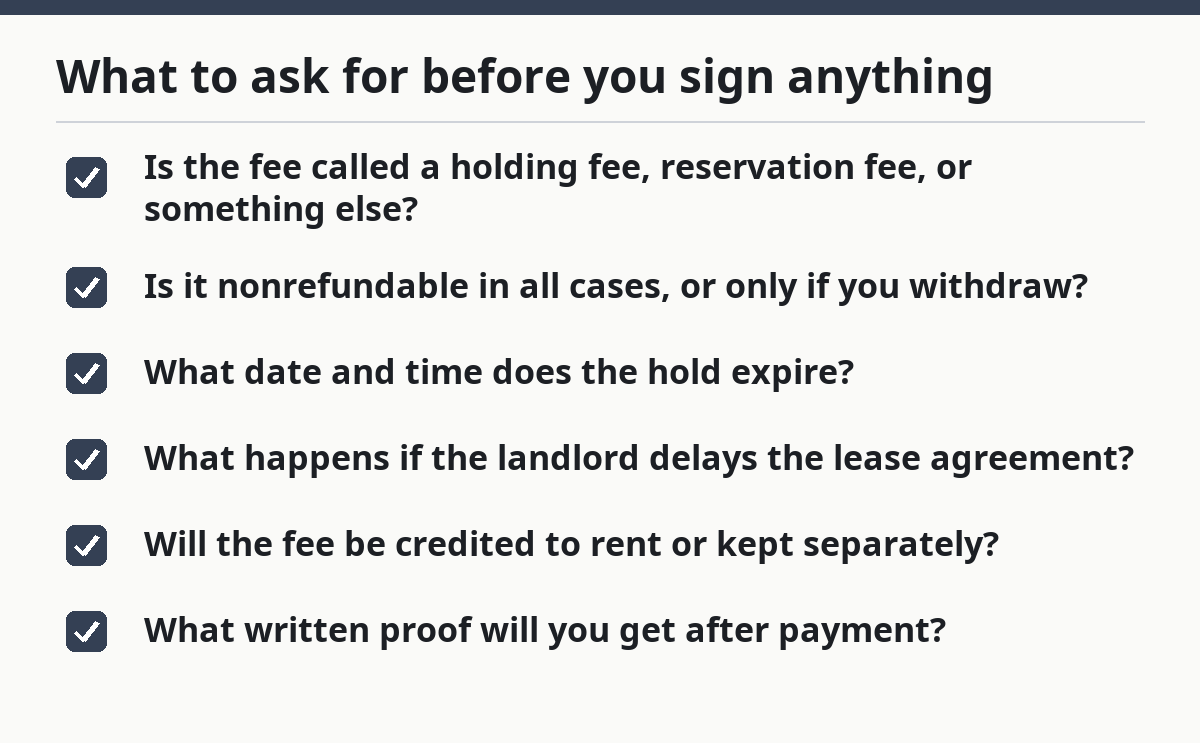
Use a short checklist before paying:
- Is the fee called a holding fee, reservation fee, or something else?
- Is it nonrefundable in all cases, or only if you withdraw?
- What date and time does the hold expire?
- What happens if the landlord delays the lease agreement?
- Will the fee be credited to rent or kept separately?
- What written proof will you get after payment?
A paper trail matters because memory fades and phone calls get described differently later. A receipt, email, or signed addendum is worth more than a verbal promise. If the landlord accepts payment by online portal, save the confirmation screen and the transaction record immediately.
This is also the moment to compare the fee with the overall move-in timeline. If you need 10 days to finish a job transfer or get roommate signatures, do not accept a 48-hour hold and hope the landlord will be flexible. Put the timeline in writing before you commit.
For renters who want to understand the larger cost picture, the hub on rental application screening and move-in costs can help place the holding fee beside the other charges that often appear during the same process. See also the tenant rights guide and the security deposits overview for related terms.
Who should be cautious or skip this fee entirely
You should be cautious if your move-in date is uncertain, your paperwork is not ready, or the unit is highly competitive and the landlord is rushing you. A nonrefundable holding fee is a poor fit for someone who still needs several days to decide, because the downside is immediate and the upside is only a temporary reservation.
It is also a bad fit when the written terms are thin. If the document is missing the exact deadline, the address, or the consequences of withdrawal, the renter is being asked to trust the landlord more than the paperwork. That is not a good trade in a financial arrangement.
People who are changing cities, waiting on job verification, or coordinating a roommate often need more flexibility than a nonrefundable hold allows. In those situations, a lease agreement that is not yet signed should not be treated as a done deal. The fee may still be fine if the terms are precise, but the margin for error is small.
A prudent renter does not pay first and sort out the details later. The better move is to ask for time, get the language in writing, and decide only after the move-in deadline and application withdrawal rules are clear.
Is a holding fee legal?
It can be, but legality depends on the written agreement and the rules in the place where the rental is located. A fee labeled nonrefundable is not automatically invalid, yet it should still be clear, disclosed, and tied to specific terms. If the wording is confusing or incomplete, get local legal help before paying. For federal consumer guidance, see the Consumer Financial Protection Bureau.
What happens if I back out after paying a holding fee?
You may lose the money. In a nonrefundable setup, backing out usually means the landlord keeps the fee unless the paperwork says otherwise or the landlord failed to honor the written terms. Save every email, receipt, and deadline notice, because those records matter if the facts are disputed. For broader housing information, check the U.S. Department of Housing and Urban Development.
Should a holding fee be written in the lease?
Yes, it should be written somewhere you can keep and review. The lease agreement itself is ideal, but an addendum or separate signed form can work if it clearly states the amount, the unit, the deadline, and whether the fee is refundable or not. Without writing, the renter is relying on memory instead of terms.
Drafted with AI; not yet reviewed by a person.