Last updated: November 19, 2026
Quick answer: a rental application completeness requirement usually comes down to 3 things: every required field filled in, every required document attached, and every required signature or consent included. In What Counts as a Rental Application Completeness Requirement?, a file can still be weak and get denied later, but if it is missing a name, a date of birth, a photo ID, income documents, rental history, or a signed consent page, a landlord can usually pause review until the missing piece arrives. For screening rules and tenant-facing disclosures, see the CFPB’s tenant screening overview and HUD’s housing resources.
Key takeaways
- A complete rental application is about paperwork being filled out, not about whether the landlord likes the answers.
- Missing one required document can make an application incomplete even if the form looks finished.
- A weak application can be complete, while an incomplete one is simply not ready for review.
- Consistency matters: names, dates, jobs, and rental history should match across every page.
- If the landlord asks for a format such as PDF, a photo, or a portal upload, that format can be part of the completeness rule.
What does “complete” mean on a rental application?
A rental application is complete when the landlord has enough information to review it without guessing. That usually means the form itself is fully filled out, the required attachments are included, and the applicant has signed every place the landlord marked as required.
Therefore, the key point is that “complete” does not mean “approved.” A landlord may still deny an application that is complete but weak on income, rental history, or references. It also does not mean every optional blank must be filled in if the landlord never asked for that item.
Because of that, a good way to think about it is this: completeness is the paperwork check, while approval is the screening check. Those are different steps, even if they happen on the same day. In housing forms, that split matters because a missing field can stop review at the door, while a bad answer can end review later.
A landlord is usually looking for a minimum set of facts:
- who is applying
- how to contact the applicant
- who will live in the unit
- where the applicant has lived before
- how the applicant earns income
- permission to verify the information
If any one of those pieces is absent, the file may be incomplete. A form with 12 pages can still be incomplete if one signature line is blank. For an overview of application screening steps, see the tenant screening guide.
Which fields usually make a rental application incomplete?
A rental application is usually incomplete when any required field, attachment, or signature is missing. The exact list depends on the landlord, the property manager, and the application form, but the same few items come up often.
The most common required fields are name, current address, phone number, email address, date of birth, current employer, monthly income, and rental history. Some applications also ask for Social Security number, emergency contact, vehicle information, or co-applicant details. If the form labels a field as required, leaving it blank is often enough to stop the review.
Documents matter just as much as the form. A landlord may ask for a photo ID, income documents, and rental history proof such as a prior landlord contact. If the applicant sends the form but leaves out the ID or pays stubs, the application may sit in the “incomplete” pile instead of moving forward. For fair housing and screening basics, see HUD’s Fair Housing information.
Here is the difference in plain terms:
| Status | What it looks like | What it usually means |
|---|---|---|
| Complete | Every required field, document, and signature is in place | The landlord can review it |
| Incomplete | One or more required items are missing | Review may pause |
| Complete but weak | Everything is submitted, but the facts do not look strong | Review can continue and still end in denial |
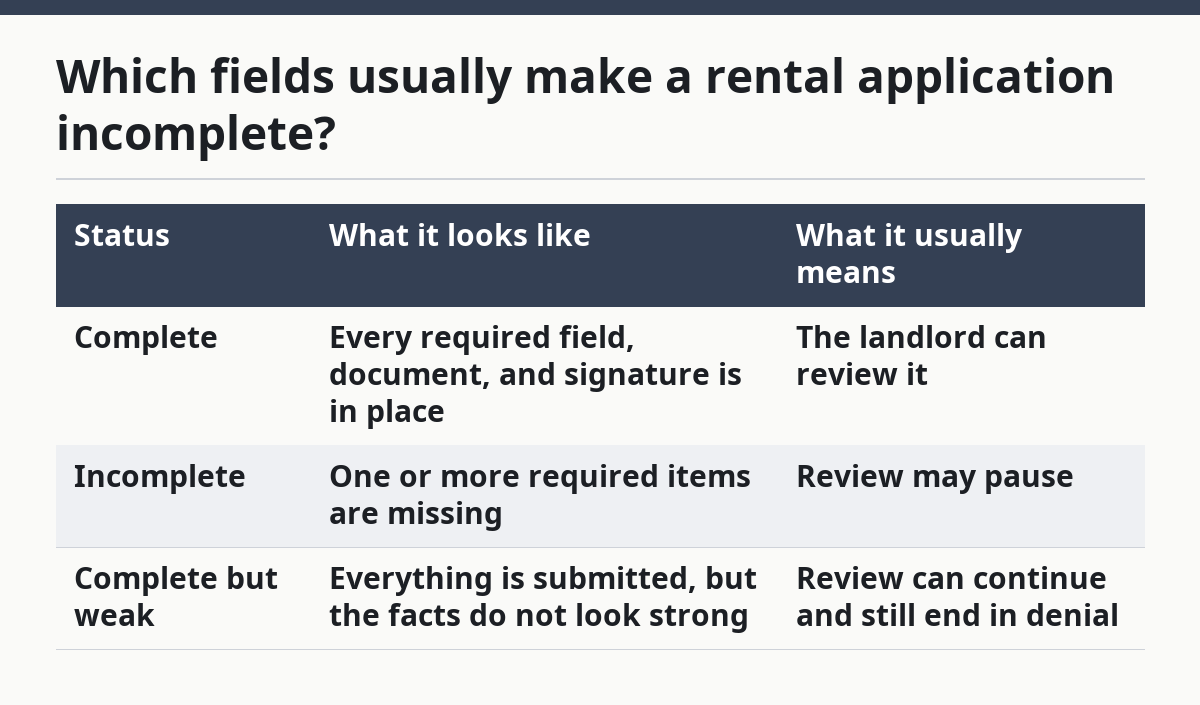
This is the line many readers miss. A blank field is a completeness problem. A low income amount, a short rental history, or a broken reference is a screening problem. They are not the same thing. For tenant-screening context, the CFPB explains how reports are used.
What documents usually have to be attached?
A rental application often requires a photo ID, income documents, and rental history materials. Those three groups are common because they help the landlord check identity, ability to pay, and past housing behavior.
A photo ID is often a driver’s license, state ID, passport, or another government-issued document. Income documents can include recent pay stubs, an offer letter, or other proof the landlord accepts. Rental history may mean the name and phone number of a prior landlord, the address of the last home, or a copy of a lease if the landlord requests it.
If the form asks for documents in PDF format, a picture from a phone may not count as complete. If the landlord asks for a scan, a screenshot with half the page cut off may also fail the completeness check. Submission format is part of the rule when the landlord says it is.
A simple way to sort the paperwork is to ask three questions before sending anything:
- Did I fill every required field on the form?
- Did I attach every required document?
- Did I use the format the landlord asked for?
If the answer to any one of those is no, the application may still be incomplete even if it looks mostly finished. That matters because a landlord may set the application aside until the missing item arrives. The Federal Trade Commission’s identity-theft guidance is also useful when a form asks for identity-related data.
How do signature and consent rules affect completeness?
A rental application is incomplete if the required signature or consent page is missing. Many applications are not just information forms; they are permission forms too. Without a signature, the landlord may not be able to verify income, rental history, or identity the way the form allows.
This is especially common when a form includes consent to contact employers, prior landlords, or screening services. If the applicant skips that page, the landlord may not have what it needs to continue. A typed name may count on one portal, while a handwritten signature may be required on a paper form. The form itself decides that detail.
Once that permission page is missing, the file may stop even if the rest of the packet is present. A landlord may require initials on specific disclosures, such as pet rules or fee acknowledgments, if the form says those initials are required. For official fair housing guidance, see HUD’s housing resources.
This is one place where a rushed application causes trouble. A person may send in every document and still miss the one signature that turns the packet into a finished file. That mistake is costly because it looks like a delay, but it can stop review for days.
A quick check before submission helps:
- every required signature box is signed
- every required initial line has initials
- every consent page is included
- every date line has a date if the form asks for one
Can a complete application still be rejected?
Yes, a complete rental application can still be rejected because completeness and approval are different things. A landlord can have every page, every attachment, and every signature in hand and still decide the application does not meet the screening standard.
That is why it helps to separate the questions. Completeness asks, “Did the applicant send everything requested?” Screening asks, “Does the information meet the landlord’s rule?” A complete application can fail on income, rental history, identity mismatch, or other screening points even when no paperwork is missing.
The strongest way to see that difference is this:
| Question | Completeness issue? | Screening issue? |
|---|---|---|
| Missing employer name | Yes | Sometimes |
| No photo ID attached | Yes | Sometimes |
| Income is below the landlord’s rule | No | Yes |
| Old eviction on record | No | Yes |
| Signature line blank | Yes | No, not yet reviewed |
A lot of frustration comes from mixing those two stages. If a landlord says the application is incomplete, that usually means it cannot be reviewed yet. If the landlord says it is complete but denied, that means review happened and the answer was no. Those are not the same outcome, even though both end the move-in path.
For a broader overview of where completeness fits in tenant screening and move-in eligibility, see the site’s hub on tenant screening and application rules.
How do you avoid a completeness problem before you submit?
A rental application is easiest to finish when you check it line by line before sending it. A 10-minute review can catch the missing items that slow the process later.
Use this order every time:
- Read the form once before filling it out. Look for required boxes, attached pages, and any note that says “must include.” That tells you what the landlord expects before you start typing.
- Fill in every required field in one sitting. Use the same legal name, current address, and contact details across the whole form.
- Attach the requested documents together. Put the photo ID, income documents, and rental history items in the same packet or upload set if the landlord asked for them. One missing file can make the whole application incomplete.
- Check every signature and date line. Make sure each required page is signed and dated if the form asks for a date. A blank signature box often stops review as fast as a missing ID.
- Match the submission format exactly. If the landlord wants a portal upload, PDF, email attachment, or paper drop-off, use that format. A complete form sent the wrong way may still be treated as incomplete in some cases, so if you are unsure, ask the landlord or a housing professional before resubmitting.
One more habit helps: keep copies of everything you send. If a landlord later says a page is missing, you can compare your copy against the file you submitted. That does not fix a missing item by itself, but it makes the next step clearer.
What mistakes make a form incomplete?
A rental application usually becomes incomplete because of small misses, not big ones. The common mistakes are blank fields, missing attachments, unsigned pages, and sending the wrong file type or format.
Blank fields are the easiest mistake to spot and the easiest to prevent. If a landlord asks for prior address history for the last 2 years and only one address is listed, the form is not finished. The same is true if the application asks for a current employer and the line is left empty because the applicant planned to “send it later.”
Missing documents cause another common problem. A person may upload the form and forget the photo ID, or attach income documents but skip the rental history page. That can delay review even when the rest of the packet looks strong.
Format mistakes are easy to overlook. A landlord may ask for a single PDF, but the applicant sends 5 separate image files. Or the landlord wants a scanned signature, and the applicant sends a typed name where a handwritten signature was expected. If the application instructions specify the format, the format becomes part of the completeness rule.
The fix is simple but unforgiving: follow the checklist the landlord gave, not the checklist you wish they had given. If the landlord asks for one page, one ID, and one income document, send exactly that unless the form says more.
What if the landlord says the application is incomplete?
If the landlord says the rental application is incomplete, the next step is to ask which item is missing and how it should be sent. The answer should be specific: a blank field, a missing document, a signature, or a file format problem.
That question matters because “incomplete” can mean very different things. It may be a missing phone number, a missing pay stub, or a consent page that never got signed. Until the missing piece is known, the applicant cannot fix the right problem.
Since the missing item may be different in each case, a careful reply is usually better than a guess. If the landlord says the income documents are missing, send the exact pages requested. If the landlord says the signature page is missing, resend the signed page in the format the landlord asked for. If the landlord says the submission was unreadable, resend a clearer copy rather than arguing about the form.
Do not assume that a complete form on your screen is complete in the landlord’s file. Scanned pages can fail to upload, emails can strip attachments, and portal uploads can time out. The safest move is to confirm the missing item in writing and keep a copy of the resend. If the issue is unclear, consider asking a housing counselor or attorney before making another submission.
Frequently asked questions
What makes a rental application incomplete?
A rental application is incomplete when it is missing something the landlord required, such as a blank field, a photo ID, income documents, rental history details, or a signature. The exact list depends on the form and the landlord’s instructions. If the landlord cannot review it without guessing, the file is usually not complete.
Can a landlord reject an incomplete application?
Yes, a landlord can usually stop or reject an incomplete application because the file is not ready for review. The reason is not the same as a screening denial. Incomplete means the applicant has not finished the paperwork the landlord asked for.
Can you add missing documents after applying?
Yes, you can often add missing documents after applying if the landlord is still accepting updates. The best move is to send the exact item that was missing and in the format the landlord requested. A late fix may put the file back into review, but it does not erase the delay.
Drafted with AI; not yet reviewed by a person.