Last updated: November 19, 2026
Key Takeaways
- A signed lease usually makes the move-in date a binding term, not a casual promise.
- A landlord can cancel only if the lease allows it or if a real legal reason makes delivery impossible.
- Put the cancellation in writing right away and ask for the unit, the reason, and any money back if you cannot move in.
- If the unit is unavailable on move-in day, the landlord has usually failed to deliver possession and may owe a remedy.
Quick Answer: Usually, no. If you have signed the lease, a landlord generally cannot cancel your move-in after you have signed the lease without a lease-based right or a legal reason. In most cases, the first 24 hours matter most because you want the facts, the paper trail, and your next steps in writing.
Can a Landlord Cancel a Move-In After You Have Signed the Lease? Usually, no: once the lease is signed, the landlord cannot simply cancel your move-in date because they changed their mind, found a higher-paying tenant, or forgot the unit was promised to you. If the landlord refuses possession anyway, that can become a breach of the lease, and you may have remedies for the cost and damage caused.
Table of contents
- What does the signed lease change?
- Can a landlord cancel a move-in after you have signed the lease?
- What should you do in the first 24 hours?
- What if the unit is unavailable on move-in day?
- What remedies do tenants usually have?
- What mistakes make this worse?
- How do owner changes or a vacant unit affect the answer?
What does the signed lease change?
A signed lease turns the move-in date into a real contract term, not a loose promise. If the lease says you get possession on the 1st, the landlord is supposed to deliver the unit on the 1st, with the property available and ready for you to occupy.
That matters because the landlord is not canceling a “holding period” anymore. They are trying to undo a deal after both sides have signed one agreement, and that is a very different problem from an application being approved. The lease usually controls the timing, the rent, and the right to possession for the full term, whether that term is 6 months, 12 months, or another set period.
If the unit is unavailable on move-in day, the issue is not just an inconvenience. The landlord may have failed to deliver what the lease promised. That can involve damages such as extra hotel costs, storage fees, lost wages from moving, and the cost of finding another place on short notice.
A good way to think about it is simple: a lease is not a reservation card. It is the document that says who gets the unit, when they get it, and on what terms.
Can a landlord cancel a move-in after you have signed the lease?
A landlord can cancel only if the lease itself gives that right or if there is a real legal reason that makes performance impossible. In ordinary cases, the landlord cannot cancel just because the owner changed plans, wanted a different tenant, or decided not to rent after all.
That means the most common answer is no. A signed lease usually binds the landlord to provide possession on the move-in date, even if the landlord later regrets the deal. If the landlord tries to back out without a lease term or a legal excuse, the problem is usually on the landlord’s side.
A few situations can change the analysis. The unit may be destroyed by fire before move-in, the building may be condemned, or the landlord may truly lack the legal right to rent the unit. Those are not the same as a last-minute business choice. They are the kinds of facts that can make the unit unavailable for reasons outside simple preference.
Here is the key line: canceling a move-in after signing is not the same as ending a lease under a normal clause. If the lease has no cancellation clause for the landlord, the landlord usually cannot just say the deal is off.
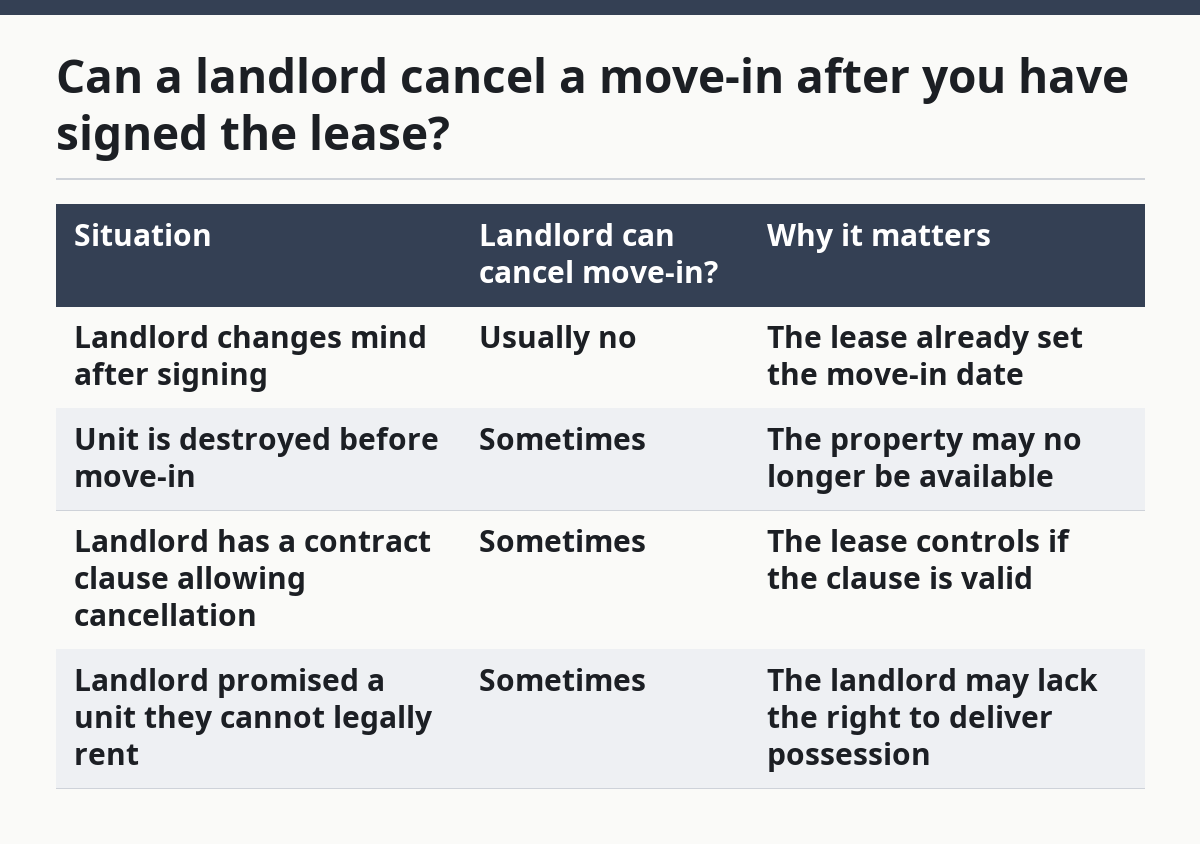
| Situation | Landlord can cancel move-in? | Why it matters |
|---|---|---|
| Landlord changes mind after signing | Usually no | The lease already set the move-in date |
| Unit is destroyed before move-in | Sometimes | The property may no longer be available |
| Landlord has a contract clause allowing cancellation | Sometimes | The lease controls if the clause is valid |
| Landlord promised a unit they cannot legally rent | Sometimes | The landlord may lack the right to deliver possession |
For tenant help on leases and housing disputes, the U.S. Department of Housing and Urban Development has resources here: https://www.hud.gov/topics/rental_assistance . For general contract guidance on lease terms and breach, the Cornell Legal Information Institute explains contract basics here: https://www.law.cornell.edu/wex/contract.
What should you do in the first 24 hours?

You should put everything in writing right away and ask for the unit, the reason for the cancellation, and your money back if the landlord will not give possession. The faster you create a paper trail, the easier it is to show that the move-in was canceled after the lease was signed.
Use this 5-step approach:
1. Read the lease line by line. Look for the move-in date, possession language, cancellation clauses, and any clause about delays or early termination. The result you want is a clean answer to one question: does the lease let the landlord back out?
2. Save every message. Keep emails, texts, portal notes, and voicemail screenshots in one folder. A 3-sentence text from the landlord can matter more than a long phone call you cannot prove.
3. Send a written demand the same day. Ask for possession on the agreed date or a written explanation of why the unit is unavailable. State that you signed the lease and are ready to move in.
4. Ask for your money back if you cannot move in. That can include deposit money, prepaid rent, or move-in fees if the unit will not be delivered. If the landlord offers a refund, get the amount and timing in writing.
5. Track your losses. Keep receipts for movers, storage, hotels, extra fuel, and any temporary housing. Those records help show damages if the dispute turns into a claim.
Do not rely on a phone promise that “the issue will be fixed soon.” A vague promise can eat up 2 days, then 5 days, and leave you with no unit and no written proof.
What if the unit is unavailable on move-in day?
If the unit is unavailable on move-in day, the landlord has usually failed to deliver possession and may owe you a remedy. “Unavailable” can mean someone else is still living there, the unit is under repair, the keys are not ready, or the landlord is refusing entry for a reason that is not in the lease.
The first problem is practical: you need somewhere to sleep, store your things, and keep your plans from collapsing. The second problem is legal: the landlord may have breached the lease by not handing over the unit when promised. A move-in date is not decorative; it is part of the agreement.
Your remedy depends on the facts. In some cases, the landlord may offer another unit, a new move-in date, or a refund. In other cases, you may decide the delay is too long and treat the lease as broken by the landlord. If you had to pay for a hotel, a storage unit, or a new mover date, those costs may be part of the damages you ask for.
A landlord sometimes argues that a short delay is not a real problem. That can be true in a narrow sense, but it does not erase the fact that you signed for a specific possession date. If the landlord pushes the date back by even a few days, the cost can still be real.
What remedies do tenants usually have?
Tenants usually have 3 main paths: insist on the unit, ask for a refund and release, or seek damages for the loss caused by the cancellation. The right choice depends on whether you still want the place and how much damage the delay has already caused.
If you still want the unit, your first move is often a written demand for possession on the move-in date or as soon as possible after it. If the landlord can cure the problem quickly, that may be the simplest fix, but if you are unsure, consult a tenant lawyer or local housing agency and get the cure in writing. If the delay is longer, you may want written terms for the new date and a credit or refund tied to the missed days.
If you do not want the unit anymore, ask for a full refund of money tied to the move-in. That can include the deposit and any prepaid rent if the lease is not going forward. Keep the request narrow and specific so the landlord cannot pretend the money was for something else.
If the delay caused measurable losses, ask for damages in writing. The kinds of losses that usually matter are extra housing costs, storage, moving company rescheduling fees, and similar out-of-pocket expenses. The more exact your records are, the easier it is to show what the cancellation cost you.
What mistakes make this worse?
The biggest mistake is often treating a verbal promise like a binding fix, but local law may vary, so ask a tenant lawyer or housing agency and keep it in writing. A landlord who says “we’ll sort it out next week” can stretch a 1-day delay into a 2-week problem, and the paper trail becomes much weaker if you never asked for written terms.
A second mistake is handing over more money before the unit is available. If you pay another deposit, another month of rent, or new move-in fees without a written explanation, you may make it harder to get that money back later. Ask for a written receipt and a clear statement of what the money covers.
A third mistake is moving in anyway without documenting the problem. If the keys are late, the locks are changed, or the unit is not ready, take photos, save texts, and write down the time. A short note that says “I arrived at 9:15 a.m. and no one could give me keys” is better than relying on memory 3 weeks later.
This issue is not for someone who wants a casual answer. If the lease is short, the move-in date is close, and the landlord is already refusing possession, the details matter. A simple “they canceled” description may hide the real question, which is whether the lease was breached and what remedy fits.
How do owner changes or a vacant unit affect the answer?
Owner changes do not erase the lease, and a vacancy does not give the landlord a free pass to cancel your move-in. If the property changes hands after signing, the new owner usually takes the property subject to existing lease obligations. That means the signed lease still matters.
Vacancy cuts the other way too. If the landlord has another empty unit, that does not automatically let them swap your deal or push you out. You signed for a specific unit, a specific move-in date, and a specific arrangement unless the lease says otherwise. A landlord cannot usually replace those terms with a different offer just because it is more convenient.
Here is the practical rule of thumb: if the lease names the unit and date, the landlord should usually treat those terms as fixed unless the lease or local law gives a lawful exit; if you are unsure, consult a tenant lawyer or legal aid resource. If the landlord says the owner changed, the building changed hands, or the unit is being held for someone else, ask for that reason in writing. A written reason is often the difference between a clean refund and a long dispute.
If you are already sorting through the lease signing and move-in process, this is the point where the paper trail matters most. A signed lease, a move-in date, and a refusal of possession are enough to create a real problem fast, so keep your records tight and your requests in writing.
Can a landlord back out after signing?
Usually no. A landlord generally cannot back out after signing unless the lease gives that right or the unit truly cannot be delivered for a legal reason. If the landlord simply changes plans, the lease still points to the original move-in date and possession terms.
What are your options if the unit is no longer available?
Your main options are to insist on the unit, accept a written refund and release, or ask for damages caused by the loss of possession. If you still want the place, demand a firm new date in writing. If you do not, ask for the return of money tied to the move-in and keep your receipts for extra costs.
Can you demand your money back if move-in is canceled?
Yes, you can usually ask for your money back if the landlord cancels the move-in and you do not get the unit. That request may cover prepaid rent, deposits, and move-in fees tied to the failed move-in. Put the request in writing and ask for a clear deadline for payment so the refund does not drift for weeks.
Drafted with AI; not yet reviewed by a person.