Last updated: November 19, 2026
Quick Answer: yes — if the repair is still active, you have dates and photos, and the landlord has not fixed it, you can usually escalate a repair complaint to a housing agency with 3 basic pieces of proof: what is broken, when you reported it, and what happened next. In a Can You Escalate a Repair Complaint to a Housing Agency? case, the first check is whether the issue is still active and documented, because a housing agency, code enforcement office, or local tenant hotline will usually want dates, photos, and a clear description of the defect before it can act.
Key takeaways
- A housing agency complaint works best when the repair problem is specific, repeated, and backed by proof.
- The strongest cases usually show the same issue over time, such as damp, mould, dangerous electrics, a broken boiler, or a serious leak.
- Some agencies can inspect the home; others take the report first and decide whether to send code enforcement or another inspector.
- A local tenant hotline can help you decide where to file and what to include.
- This step is useful when repair letters have gone nowhere, but it is not the same as rent withholding or repair-and-deduct.
What does a housing agency complaint do?
A housing agency complaint asks a public office to step in when a repair problem may be a habitability issue, not just a private disagreement with a landlord. The agency can log the repair complaint, refer it to code enforcement, or arrange an inspection if the facts point to a health or safety risk.
This route matters when the issue is bigger than a loose handle or a cosmetic chip. Conditions tied to heat loss, water damage, mould, broken wiring, or an unsafe room can fit into an inspection process because the question becomes whether the home meets minimum standards. In the UK, the Housing Health and Safety Rating System, or HHSRS, is the standard used to assess hazards, and it identifies risks such as damp, mould, or dangerous electrics according to Contend Legal and GOV.UK.
That does not mean every complaint gets the same result. A housing agency may only record the problem at first, then decide whether a code enforcement visit or another follow-up is justified. This is why the cleanest complaint is short, factual, and easy to check.
The best fit for this route is often a tenant who has already tried the normal repair channel and still has the same issue. It is not the right first move for a reader who has not yet told the landlord about the defect, and it is not a substitute for emergency services if the condition creates an immediate danger.
When should you escalate instead of waiting?
You should escalate when the repair problem looks urgent, repeats after promises to fix it, or creates a clear health or safety risk. A broken boiler in winter or a serious leak should usually be fixed urgently, within 24 hours according to Contend Legal, so waiting through another long silence can make the condition worse.
Escalation also makes sense when the same defect keeps coming back after a repair visit. A patch job that fails after a few days is not the same as a real fix, especially if the underlying cause is still there. In that situation, a housing agency complaint can give the case a second set of eyes.
This is the point where many tenants make the wrong call: they keep sending the same message for weeks without changing the path. A rent problem or a general complaint line may not trigger an inspection. A repair complaint to a housing agency can be a better step when the issue is tied to habitability, not just inconvenience.
The limit is real, though. If the problem is minor, such as a scuffed wall or a cabinet hinge, a public agency may not treat it as a code issue. If you are unsure whether the issue qualifies, consult a local tenant hotline, housing adviser, or local housing professional before filing. That is why the strongest complaint names a concrete hazard, not a vague sense that the flat is in poor shape. If the condition is urgent or dangerous, the tenant should not wait for the perfect paper trail before asking for help.
How do you file a repair complaint with a housing agency?
You file a repair complaint with a housing agency by giving the agency the defect, the location, the dates, and the proof it needs to decide whether to inspect. The process usually starts with a phone call, online form, or tenant hotline, and then the agency decides if the case should move to code enforcement or inspection.
-
Write down the exact problem in one sentence. Name the room and the defect, such as a leaking ceiling, a boiler that does not heat, or wiring that sparks. A clear description gives the agency a specific issue to log, not a general complaint about the whole property.
-
List the dates you reported it and what happened next. Keep the timeline simple: first report, any follow-up, any repair visit, and whether the defect came back. A 3-step timeline is easier for the agency to review than a long story with no dates.
-
Collect proof that shows the condition. Photos, short videos, copies of messages, and notes from visits help the agency see what the tenant sees. If there is mould, damp, or water damage, the pictures should show the affected area and not just a close-up of one stain.
-
Send the complaint to the right channel. If a local tenant hotline exists, start there and ask where the repair complaint should go. Some public systems, such as the NYCHA Customer Contact Center, take these reports 24 hours a day, 7 days a week according to NYC311, which shows how some agencies handle repair reporting around the clock.
-
Ask whether an inspection is part of the process. The goal is not just to leave a record; it is to trigger the next step if the condition looks serious enough. If the agency uses code enforcement or a housing inspection system, ask what evidence or access it needs to complete the review.
-
Keep a copy of the complaint and the reference details. A complaint number, case note, or confirmation screen helps if the problem is later escalated again. Without a record, the tenant may have to start over and repeat the same facts.
The biggest mistake here is overloading the complaint with opinion. A page of frustration may feel honest, but a housing agency usually needs facts it can verify. The better version is short, dated, and tied to the actual repair problem.
What evidence should you include in a complaint?
You should include evidence that shows the defect, shows how long it has been there, and shows that the landlord already knew about it. Photos and videos are the most useful starting point, but they work better when they are paired with dates and short notes.
The strongest complaint file usually includes five things: the repair problem itself, the exact room or address, the date each message was sent, any reply, and any proof that the condition remained after a promised fix. If the issue is damp, mould, a leak, or dangerous electrics, the evidence should make the hazard visible without a long explanation.
A common error is sending only one blurry photo and hoping the agency fills in the gaps. That can cost time because the file may look too thin to support an inspection request. A better approach is a small, clear set of proof rather than a pile of unrelated screenshots.
If the agency accepts a phone report first, it still helps to have the documents ready before the call ends. A caller who can give dates, locations, and a short summary often makes the case easier to log. A local tenant hotline can help shape that first report, but the tenant still needs the same basic evidence.
Can a housing agency inspect the property?
Yes, a housing agency can inspect the property when the repair complaint suggests a health or safety issue that needs a check in person. That inspection is often the step that turns a complaint into code enforcement, because the agency can compare what the tenant reports with what is actually present.
Inspection matters because some defects are hard to judge from words alone. A leak may stain one wall and run behind another. A room may look fine in a photo but still have damp, mould, or unsafe wiring that only becomes clear during a visit.
The standard used in the UK is the Housing Health and Safety Rating System, which assesses hazards such as damp, mould, or dangerous electrics according to Contend Legal and GOV.UK. That matters because the complaint is not just about poor upkeep. It is about whether the home crosses into unsafe conditions.
The trade-off is delay. An inspection can support the case, but it is not instant. If the problem is serious and the home is getting colder, wetter, or more dangerous, the tenant should treat the complaint as urgent rather than waiting for a perfect inspection date. A broken boiler in winter or a serious leak can justify immediate escalation because the harm grows with time. If the hazard is severe, consult a housing professional or local authority officer about emergency reporting.
Which route fits your problem?
The right route depends on what kind of repair problem you have and how fast it needs action. A housing agency complaint is best for habitability issues, especially when there is proof that the defect is real, ongoing, and serious enough for an inspection.
| Route | Best for | Main limit |
|---|---|---|
| Housing agency complaint | Unsafe or stubborn repair problems tied to habitability | May need time before inspection happens |
| Code enforcement | Defects that may breach minimum standards | Can depend on local rules and case triage |
| Local tenant hotline | Help finding the right office and process | Usually does not fix the problem by itself |
| Direct landlord report | First step for any repair problem | Can stall if the landlord does not act |
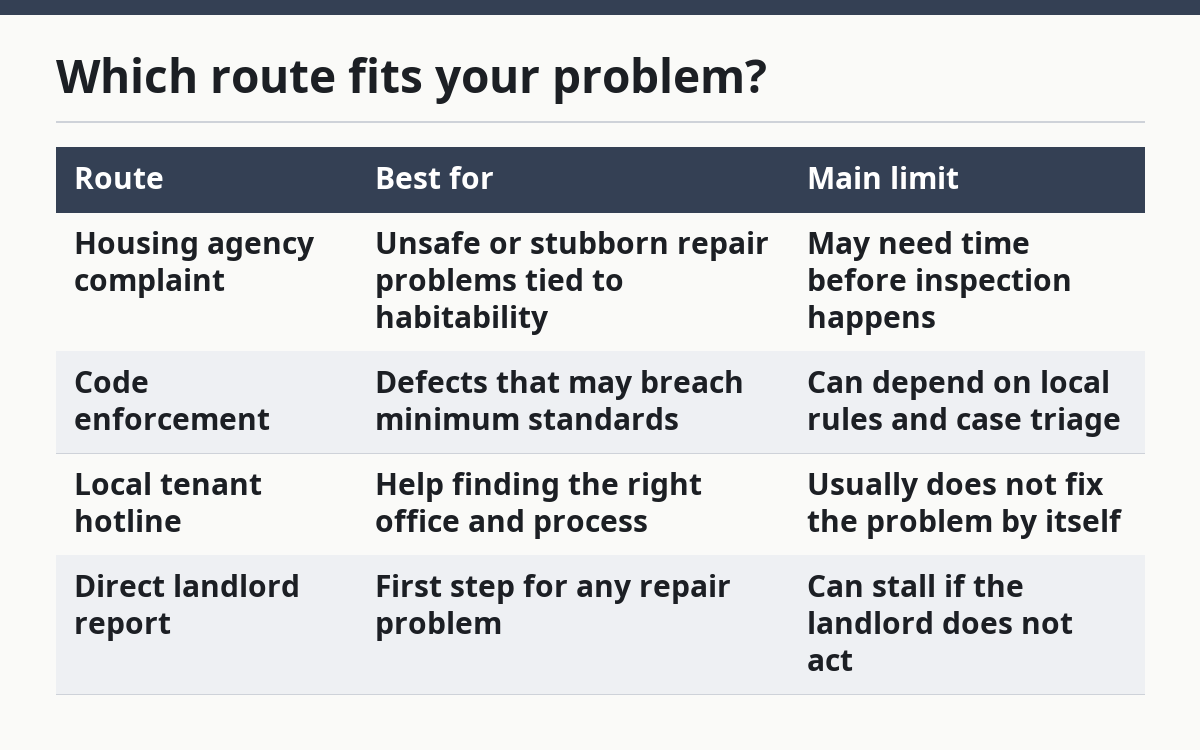
This comparison matters because a lot of tenants try only one channel and assume the rest are the same. They are not. A direct repair request may be the first step, while a housing agency complaint is the escalation step when the problem has not been fixed or looks unsafe.
This route is wrong for someone who wants a private money dispute handled by a public office. It is also wrong for someone who has no evidence and no dates, because the agency may have nothing solid to act on. The strongest complaints are narrow, factual, and tied to a specific condition, not a general feeling that the landlord is careless.
When should you use a local tenant hotline?
You should use a local tenant hotline when you are not sure which office takes the complaint or when you need help deciding whether the problem belongs with housing, code enforcement, or another inspector. A hotline can save time by pointing you to the correct filing path before the condition gets worse.
This is especially useful if the tenant has a mixed problem, such as a leak that may have caused mould or a heater issue that also damaged walls. A hotline can help sort the issue into the right complaint process, which matters because the agency may ask for different facts depending on the defect.
Some systems are built for fast intake. NYC311 says the NYCHA Customer Contact Center takes repair reports 24 hours a day, 7 days a week, which shows how some housing systems handle complaints outside normal office hours. That does not guarantee a fix, but it does mean the report can be logged without waiting for business time.
The limit is that a hotline is a doorway, not the solution. If the tenant never follows up with the evidence or never asks for the next step, the complaint may stay stuck at intake. Use the hotline to start, then keep the complaint file ready for inspection or code review.
What should you do if the agency still does nothing?
You should follow up, ask what the case needs next, and keep the complaint record moving if the condition remains unchanged. A silent agency does not mean the problem disappeared, and a single missed call should not be treated as the end of the process.
The practical move is to keep the record tight: one summary, one timeline, one set of photos, and one clear ask for inspection or review. If the agency says the complaint needs more detail, add only what is missing. If it says the issue goes to code enforcement, ask for the next step and keep the reference details.
Because of that, this is also the point to stop treating the issue like a casual request. When a broken boiler, a serious leak, mould, or dangerous electrics are still present, the problem is no longer just inconvenience. It is a repair complaint that may need public follow-up. If the condition is severe, consult a housing adviser or local authority before you assume the delay is normal.
The honest drawback is that escalation can take time and still not produce a fast fix. That is why the best complaint is the one that is easy to verify, hard to ignore, and already organized before the first call ends.
What evidence should you include in a complaint?
You should include proof that shows the defect, the date you noticed it, and the steps you took before filing. Photos, short videos, and copies of messages are the core pieces, because they show the condition without guessing.
Add the address or unit, the room, the date of each report, and any response you received. If the issue got worse after a repair visit, say that plainly. A timeline with 3 or 4 dated points is usually more useful than a long explanation with no order.
A complaint with no evidence can still be filed, but it is weaker. The agency may not know whether the issue is ongoing, fixed, or too vague to inspect. Clear proof helps the agency decide whether the case belongs with inspection, code enforcement, or a tenant hotline follow-up.
Can an agency order an inspection?
Yes, an agency can order or arrange an inspection when the repair complaint suggests a condition that needs a physical check. That is often how the agency confirms whether the problem rises to a code or habitability issue.
Inspection is useful because some hazards are not obvious in text. Damp, mould, leaks, and dangerous electrics can be reported more clearly when someone looks at the space in person. In the UK, the Housing Health and Safety Rating System is used to assess these hazards according to Contend Legal and GOV.UK.
The main limit is timing. A complaint can lead to inspection, but the process may still take longer than the tenant wants. If the issue is urgent, such as a broken boiler in winter or a serious leak, the complaint should be filed as soon as possible rather than waiting for conditions to improve on their own.
Should you notify the landlord before filing?
Yes, you should usually notify the landlord before filing because the agency will often want to see that the landlord had a chance to fix the repair problem. A repair complaint with no prior notice can be harder to assess, especially if the issue is not an emergency.
That said, notice is not the same as delay. If the problem is serious, unsafe, or getting worse, the tenant should not wait weeks just to build a perfect file. Report it, keep the evidence, and move to the housing agency if the landlord does not act.
The useful rule is simple: tell the landlord, document the date, and escalate if the response is slow or the condition remains. That gives the agency a cleaner case and gives the tenant a better chance of showing the problem is real and unresolved.
Drafted with AI; not yet reviewed by a person.