Last updated: November 19, 2026
Quick Answer: Yes—a landlord can ask for a holding fee and still require full move-in money, but only if the fee is handled the right way and clearly credited or accounted for in writing. In the United States, a $500 holding fee can still be followed by a full move-in request if the paperwork says the fee is separate; in England, GOV.UK says holding deposits are limited to 1 week’s rent and must be handled under the tenant fees rules, so check the local rules before paying. The red flag is double charging: taking one payment to reserve the place, then acting as if that payment never existed when the lease starts.
Key takeaways
- A holding fee and move-in money can both appear on the same deal, but the paper trail has to show how each one is used.
- A receipt matters because it shows whether the holding fee was meant to go toward rent, deposit, or another move-in charge.
- If the landlord asks for full upfront money after already taking a holding fee, the key question is whether the fee is deducted or simply ignored.
- A prudent move is to get the crediting terms in writing before you hand over any payment.
- If the numbers do not add up on the lease, the landlord may be asking for more than the deal allows.
What does the holding fee change?
A holding fee changes the math, not the need for paperwork. It is usually meant to reserve the unit for a set period while the landlord takes the place off the market, but that does not automatically mean the landlord must lower every move-in charge unless the agreement says so.
The issue is simple: if the landlord collects a holding fee on day 1 and then asks for rent, deposit, or other move-in money on lease signing, the landlord should show exactly how the first payment fits into the second. A receipt that says “credited to first month’s rent” is different from a receipt that says “administrative fee” or “reservation fee.”
That difference matters because the same $500 can be treated in more than one way on paper, so a tenant should check the written terms or consult a local housing professional if the crediting is unclear. If the fee is meant to count toward rent, the move-in total should drop by that amount. If it is not credited, the landlord should explain why the full move-in amount is still due.
A clearer rule helps here: a holding fee is not the same thing as a security deposit, and it is not always part of the rent unless the lease or receipt says it is. If the landlord uses vague words and no accounting, the tenant has less protection and more room for a billing dispute.
Can a landlord ask for both at once?
A landlord can ask for both at once if the holding fee is separate from the move-in charges and the terms are clear. That is common when the landlord wants the tenant to show commitment before the lease is signed, then still collect the normal move-in amount on the start date.
The problem is not the timing alone. The problem is a hidden second charge. If the holding fee was supposed to hold the unit for 7 days and be applied to the lease, then asking for the full move-in amount without crediting the fee can look like double charging. If the fee was never meant to reduce the move-in total, the landlord should say that in writing before any money changes hands.
A clean paper trail avoids most arguments. The lease offer, receipt, or written confirmation should show three things: what the holding fee is for, whether it is credited to the move-in total, and what money remains due on move-in day. Without that, the tenant is guessing.
Here is the practical test I would use: if the landlord cannot show the total due after subtracting the holding fee, then the accounting is not finished. A landlord who asks for “full move-in money” after taking a holding fee may be doing it properly, but only if the receipt and lease math show why the total is still full.
How should the money be credited?
The holding fee should be credited in the way the receipt or lease says, and the credit should be visible in the final total. The move-in amount should not be a mystery math problem at signing.
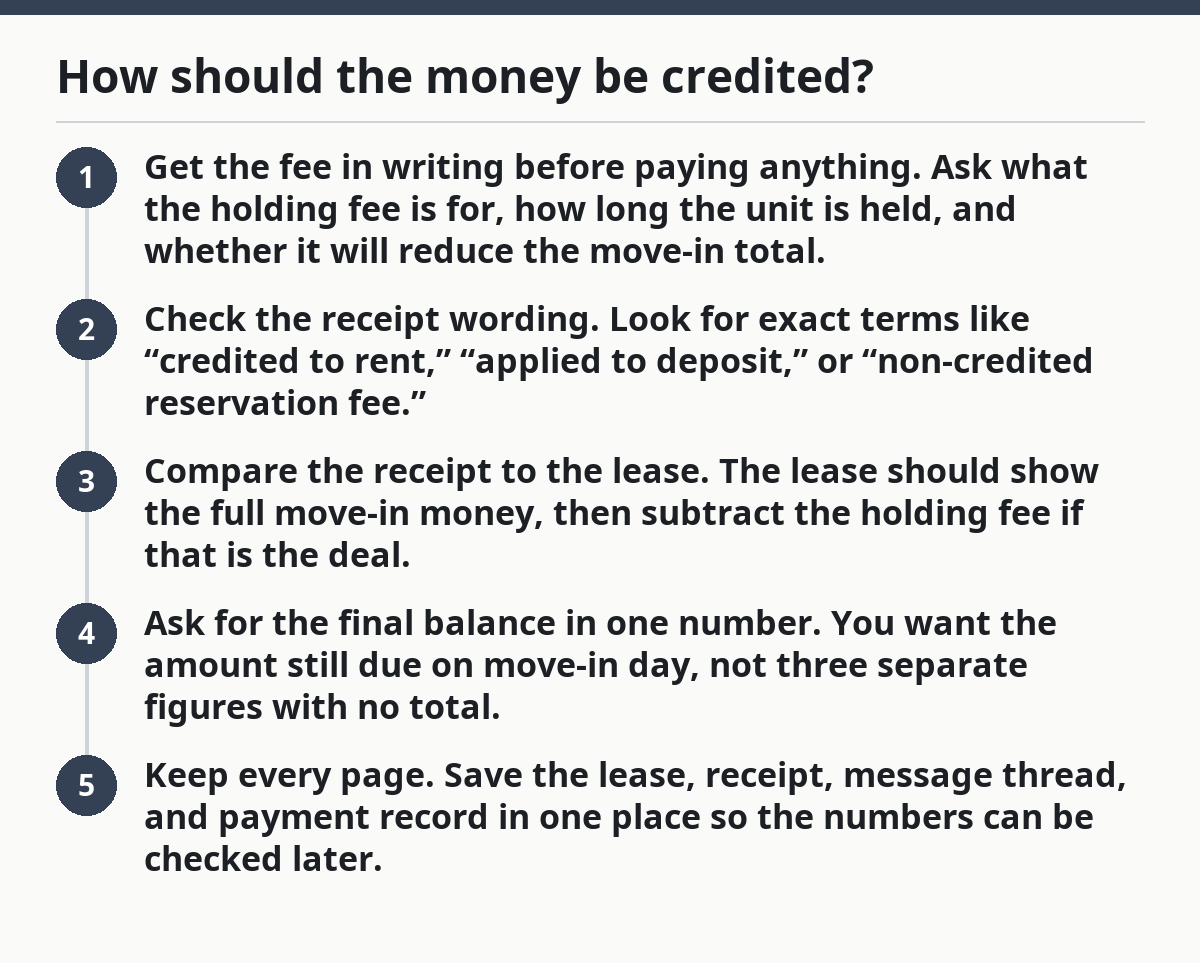
Use this as the basic process:
- Get the fee in writing before paying anything. Ask what the holding fee is for, how long the unit is held, and whether it will reduce the move-in total.
- Check the receipt wording. Look for exact terms like “credited to rent,” “applied to deposit,” or “non-credited reservation fee.”
- Compare the receipt to the lease. The lease should show the full move-in money, then subtract the holding fee if that is the deal.
- Ask for the final balance in one number. You want the amount still due on move-in day, not three separate figures with no total.
- Keep every page. Save the lease, receipt, message thread, and payment record in one place so the numbers can be checked later.
If the landlord gives only a verbal promise, that is weaker protection, so it is wise to confirm the terms in writing and check local rules or speak with a housing adviser. A receipt is stronger because it creates a record that can be read later, after the pressure of move-in day has passed.
This also helps with the common “application fee vs. holding fee” confusion, but that is a separate issue. Here, the key point is crediting: the same money cannot be both taken and ignored unless the written terms clearly allow it.
What counts as double charging?
Double charging happens when the landlord keeps the holding fee and then still demands the same amount again as part of full move-in money without giving a credit or explanation. The result is that the tenant pays twice for the same slice of the deal.
A landlord may still collect several move-in charges at once — for example, rent plus deposit plus another fee — but the total should be honest and traceable. If the holding fee was meant to reserve the unit, and the landlord later counts the full move-in money as though no fee was paid, that is the part to question.
The cost of missing this is simple: a tenant can overpay before the lease even starts. The accounting should show the original holding fee, the credited amount, and the exact balance due.
One useful standard is plain arithmetic. If the landlord collected money on day 1 and still wants full move-in money on day 10, the receipts should show why the first payment did not reduce the second. If they cannot show that, the tenant should consider the bill disputed until the math is clear and may want to consult a local attorney or housing office.
For broader move-in charge questions, the hub page on move-in charges, deposits, and fees is the right place to start. This article only covers how a holding fee affects the later move-in total.
What should the receipt say?
The receipt should say what the payment is for and whether it will be used later. A good receipt is short, specific, and easy to match to the lease.
Look for these details on the receipt: the amount paid, the date, the unit address or reference, the label for the payment, and the rule for crediting it. If the receipt says the holding fee is “applied to first month’s rent,” the move-in total should reflect that. If the receipt says it is “nonrefundable” but does not say whether it is credited, that leaves a gap the tenant should close before paying more.
A missing credit is not proof of wrongdoing, but it is a strong reason to pause and ask for clarification. A landlord may say, “Your full move-in money is still due,” while the tenant assumes the holding fee already reduced the total. The receipt is the quickest way to settle that. If the paper says one thing and the landlord says another, the paper usually matters more.
If the landlord refuses to give a receipt, that is a bad sign. It does not prove the charge is wrong, but it makes the deal harder to verify and easier to dispute later.
What if the landlord says the fee is not credited?
If the landlord says the fee is not credited, the question becomes whether that rule was disclosed before payment. A fee can be separate from move-in money, but it should not turn into a surprise after the unit is reserved.
This is the point where the deal may stop being a fair bargain and start becoming a warning sign. If the tenant was told the fee would “hold” the unit, but later learns it does not reduce rent, deposit, or any other move-in charge, the tenant may feel misled even if the landlord thinks the paperwork was enough.
The honest trade-off is this: a non-credited holding fee can be lawful in some places and unfair in practice if the terms were not plain from the start. That is why the best protection is a written line before payment that says whether the fee is a credit, a separate charge, or something else.
This page does not answer every refund rule, and it does not answer when a holding deposit is refundable. The narrower question here is whether the landlord can still demand all move-in money after taking a holding fee. The answer depends on crediting and disclosure, not on wishful thinking, and a tenant should check local law or a qualified adviser if the wording is unclear.
When should a tenant push back?
A tenant should push back when the landlord cannot show the final total after the holding fee is applied. The strongest warning signs are a missing receipt, a lease that does not mention the fee, or a demand for full move-in money that ignores an earlier payment.
A simple reply can reset the conversation: ask for the move-in statement in writing, with the holding fee listed and deducted if it is supposed to count. That keeps the dispute on numbers, not feelings. If the landlord truly intends the holding fee to be separate, the written accounting should make that obvious in one page, not three texts.
If the landlord’s explanation stays verbal, that is weaker protection, so the tenant should consider checking GOV.UK, Citizens Advice, or a local tenant-rights resource before paying more. A verbal promise is too weak when the issue is money due on a lease, and the safest path is to stop until the figures are clear.
For England, the GOV.UK tenant fees guidance and Citizens Advice pages are useful places to check the current rules before paying anything. If the situation is outside England, the same habit still helps: get the fee, the credit, and the move-in total in writing first.
Can a landlord charge a holding fee and still ask for full move-in money?
Yes, if the holding fee is separate and the lease paperwork shows why the full move-in amount is still due. The key is not whether the landlord asks for both, but whether the tenant gets a clear credit or a clear statement that no credit will be given.
If the landlord already took a holding fee and then wants the entire move-in amount again without adjusting the math, that can be a double charge. The clean answer is to demand a receipt and a written balance before paying the rest. If the numbers line up, the request may be legitimate; if they do not, the tenant should challenge it.
Should a holding fee reduce move-in costs?
It should reduce move-in costs if the landlord says it will be credited. The receipt or lease should show the deduction in plain language and on the final balance due.
If the paperwork says the fee is separate, then it may not lower the move-in total. That is why the written terms matter more than the label alone.
Can the landlord keep a holding fee and still ask for all upfront rent?
Yes, but only if the fee is not meant to count toward rent and the tenant agreed to that in writing. The total due should still be transparent.
If the landlord says the fee was just to reserve the unit, the receipt should say that clearly. If the fee was supposed to be part of rent, asking for all rent again is a problem.
What if the holding fee is not credited?
If the holding fee is not credited, the landlord should have said so before payment and the receipt should match that rule. The tenant should ask for a written explanation showing why the full move-in money is still due.
If no such explanation exists, the prudent move is to dispute the charge before paying more. A missing credit is not proof of wrongdoing, but it is enough reason to pause.
Drafted with AI; not yet reviewed by a person.