Last updated: November 19, 2026
What Should You Check on a Lease Before Paying Move-In Money? Check the lease line by line before you pay anything, and only hand over move-in money when the lease names the exact amount, what each charge is for, when it is due, and how you will get a receipt. That means the security deposit, first month’s rent, any holding deposit, and any move-in statement should all match what you were told in writing. For a quick legal overview of rent and deposits, see the CFPB’s renting guidance and HUD’s tenant resources at HUD.gov.
Key takeaways
- Do not pay from memory or from a verbal promise; use the lease and any written addendum.
- The lease should spell out each move-in charge by name, not just a single lump sum.
- Due dates matter as much as dollar amounts, because a payment can be “late” the same day it is due.
- A receipt should show the date, amount, payee, and what the money covers.
- If the lease is vague about proration, condition of delivery, or deposit labels, fix that before money changes hands.
What exactly should the lease say?

The lease should name each move-in charge in plain words and tie it to a date, an amount, and a purpose. You are looking for the lease, the security deposit, the first month’s rent, any holding deposit, and any move-in statement to be listed clearly, not buried in a paragraph of fine print.
A solid lease usually shows:
- the full rent amount for the first month
- any prorated rent, if your start date is not the first of the month
- the security deposit amount
- any holding deposit or application money already paid
- the exact due date for each payment
- who gets paid and how
However, a lease can say “move-in funds due at signing” without telling you whether that means one payment or several. If the lease does not break the charges into separate lines, you do not yet know what you owe. A clear lease leaves little room for surprise, and a vague lease is the first sign that you need to slow down.
Therefore, do not rely on a landlord’s spoken explanation if the paper says something else. A lease is the document that controls the payment terms, not the memory of a conversation in a hallway or over the phone. If the numbers in the lease and the numbers you were told do not match, stop there and ask for a corrected version before paying.
How do you check the move-in payment terms?
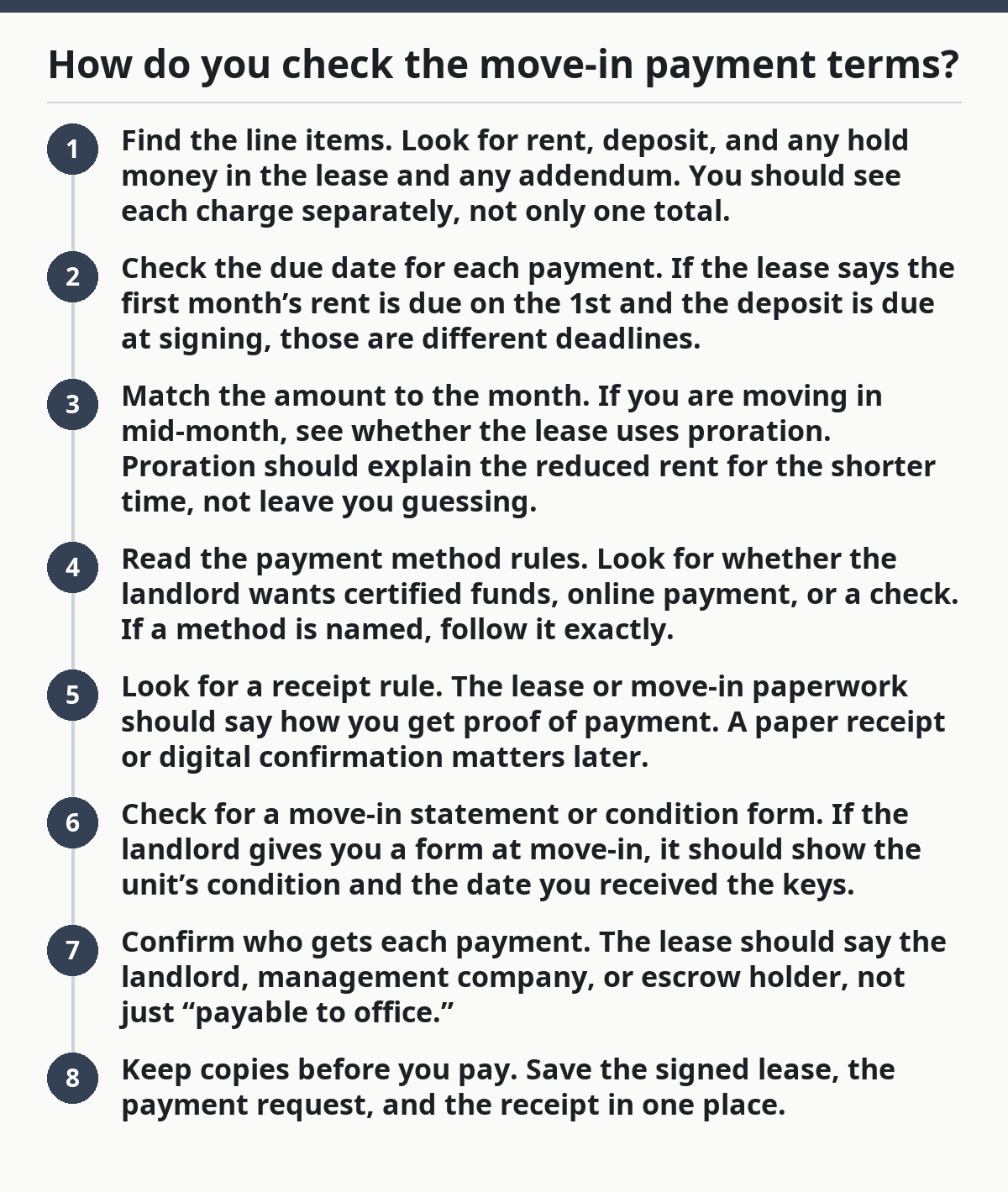
You check the move-in payment terms by matching each charge in the lease against the amount, date, and label on the payment request. The goal is to make sure every charge has a name before you send the move-in money.
Use this simple order:
- Find the line items. Look for rent, deposit, and any hold money in the lease and any addendum. You should see each charge separately, not only one total.
- Check the due date for each payment. If the lease says the first month’s rent is due on the 1st and the deposit is due at signing, those are different deadlines.
- Match the amount to the month. If you are moving in mid-month, see whether the lease uses proration. Proration should explain the reduced rent for the shorter time, not leave you guessing.
- Read the payment method rules. Look for whether the landlord wants certified funds, online payment, or a check. If a method is named, follow it exactly.
- Look for a receipt rule. The lease or move-in paperwork should say how you get proof of payment. A paper receipt or digital confirmation matters later.
- Check for a move-in statement or condition form. If the landlord gives you a form at move-in, it should show the unit’s condition and the date you received the keys.
- Confirm who gets each payment. The lease should say the landlord, management company, or escrow holder, not just “payable to office.”
- Keep copies before you pay. Save the signed lease, the payment request, and the receipt in one place.
Specifically, this process catches the most common problem: paying the right total for the wrong reason. A tenant can hand over the right amount and still be left exposed if the lease does not show what the money covers. That is especially true when a holding deposit later gets credited toward rent or when a move-in statement changes what the landlord says was accepted.
Meanwhile, if you need a plain-English lease review, compare this page with the lease signing checklist and lease clause guide. Those pages cover the broader contract terms; this page stays on move-in money.
Is the deposit labeled correctly?

The deposit should be labeled exactly the way the lease uses it, because the label tells you what the money is supposed to do. A lease that says “security deposit” is different from one that says “holding deposit,” and the paperwork should not use those terms interchangeably.
This matters because labels affect expectations. A security deposit is usually tied to possible damage or unpaid rent. A holding deposit is usually tied to taking the unit off the market for a set time. If the lease or receipt uses only the word “deposit” with no extra detail, that is not enough for a careful payment.
Look for these details:
- the exact label
- the exact amount
- whether it is refundable
- when it is credited, if at all
- what event causes it to be kept or returned
However, a missing label can create a later argument about what the money was for, even if the amount itself is not large. If the lease says one thing and the payment receipt says another, ask for a corrected document before you pay. A clean paper trail is worth more than a verbal promise made at the counter.
For a broader lease clause review, the lease signing and clause hub should sit next to this one. That page covers the bigger contract picture; this page is only about the move-in payment terms.
What should you look for about due dates and proration?
You should look for exact due dates and a clear proration formula if your move-in day is not the first of the month. Without those details, you cannot tell whether the first payment is fair or even complete.
Proration should answer three questions:
- what day your rent starts
- what period the first payment covers
- how the landlord calculates the shorter month
For example, if the lease starts on the 12th and the rent cycle begins on the 1st, the lease should show how the rent is split between the partial month and the next full month. The point is not to do the math yourself from scratch; it is to see that the lease actually gives you the math in writing.
Due dates matter for another reason: a payment can be late the moment the date passes. If the lease says “due upon signing,” then waiting a day can be a problem even if your move-in date is later. If it says “due before key release,” then you need proof of payment ready before you pick up the keys. That difference is small on paper and big in practice.
Therefore, a lease that is silent on proration is a warning sign. So is a lease that gives only a total first-payment number with no breakdown. If the unit starts mid-month, the paperwork should explain why you are paying the amount shown. If it does not, ask for a revised page or an addendum that spells it out.
What receipts and papers should you get?
You should get a receipt that shows the date, the amount, who got the money, and what it was for, plus copies of the lease and any move-in statement. A plain handwritten note is better than nothing, but a proper receipt is much better.
At minimum, keep:
- the signed lease
- the payment receipt
- any move-in statement or condition form
- any email or text that confirms the amount due
- proof of the payment method used
The receipt should match the lease terms. If the lease says the money is for first month’s rent and security deposit, the receipt should not just say “deposit received” and stop there. If you pay by check or online transfer, save the confirmation with the date and amount. If you pay in person, ask for a written receipt before you leave the office.
Specifically, the move-in statement matters because it records what the unit was like when you took possession. It belongs in the same folder as the payment records because both documents set the starting point. If the landlord gives you only one copy, ask for another. If there is a move-in inspection form, sign only what you understand. For a federal tenant-rights overview, see HUD’s rental assistance page and the FTC’s advice on keeping records.
When should you stop and ask for a revised lease?
You should stop and ask for a revised lease when the payment amount, due date, or label does not match the paperwork you were given. Paying first and fixing the paper later is the wrong order, because the paper is what protects you when the account is questioned.
This is the point where a generic checklist is not enough. If the lease is missing the security deposit amount, hides proration in a note, or changes the move-in money in a last-minute email, the correct move is to pause. A clean correction now is easier than trying to sort out a mismatch after you have already paid and collected the keys.
This page is not for deciding whether a landlord can charge a fee you dislike, and it is not for arguing about a deposit after move-in. It is for one decision only: should the lease be fixed before money leaves your account? The answer is yes if the document is unclear. A lease should be readable before you pay, not after.
Ultimately, that caution is especially important if the unit is already empty and you feel pressure to sign fast. A rushed signature can hide a bad payment term in a paragraph that looks harmless. A one-day delay to correct the lease is usually cheaper than a week of confusion later.
Should I pay before signing?
No, not unless the lease and the payment request are in writing and fully match. Paying before signing makes it harder to prove what the money was supposed to cover. If the landlord wants funds first, ask for the signed lease, the exact due date, and a receipt that names the charge.
What if the money due does not match the lease?
Do not pay the mismatch until the paperwork is corrected. A number that appears only in email, text, or a verbal statement should not replace the lease. Ask for a revised lease or written addendum that shows the same total and the same labels before you send any funds.
What receipts should I get at move-in?
Get a receipt that shows the date, amount, payee, and purpose of the payment. Keep the signed lease and any move-in statement with it, plus proof of how you paid. If the receipt does not identify the charge clearly, ask for one that does before you leave.
Drafted with AI; not yet reviewed by a person.