Last updated: November 19, 2026
Quick Answer
A lease clause is usually unenforceable against a tenant when it conflicts with state law, tries to waive basic tenant rights, or demands something the landlord cannot legally require. In practice, the most common trouble spots are waiver clauses, repair-shifting clauses, entry clauses, and some late-fee or attorney-fee clauses.
Key takeaways
- A clause can look valid and still fail if it contradicts state law or local housing rules.
- Landlords usually cannot contract around nonwaivable tenant rights, even if the lease says the tenant “agrees” to it.
- Waiver language, extreme attorney-fee terms, repair-shifting clauses, broad entry clauses, and some late-fee terms are common trouble spots.
- The lease language is not the end of the story; the law that governs the rental controls.
- If a clause would let a landlord avoid habitability duties, sidestep notice rules, or punish a tenant for asserting rights, it is a red flag.
The lease clause that matters most: what fails when law and paper collide
A lease clause fails when it tries to override mandatory state law or tenant rights that the law does not allow either side to waive. That is the core rule, and it shows up in ordinary rental contracts more often than tenants expect.
A lease is a contract, but rental law is not optional. If a clause says one thing and state law says another, the law wins. That is true for many issues that show up in a standard residential lease: notice before entry, duty to maintain the unit, limits on penalties, and the right to sue or defend yourself in court. The paper can still be signed; that does not make every sentence enforceable.
This is where tenants get trapped. A clause may be written in clean, confident language and still be unenforceable against the tenant. Some landlords use broad wording such as “tenant waives all claims,” “tenant accepts premises as-is,” or “tenant agrees landlord has no repair duties.” Those phrases can sound final. They are not magic.
The practical test is simple. Ask three questions about the clause:
- Does state law allow this term at all?
- Does the clause try to remove a right the tenant cannot waive?
- Does it punish ordinary tenant conduct that the law protects, such as asking for repairs or contesting charges?
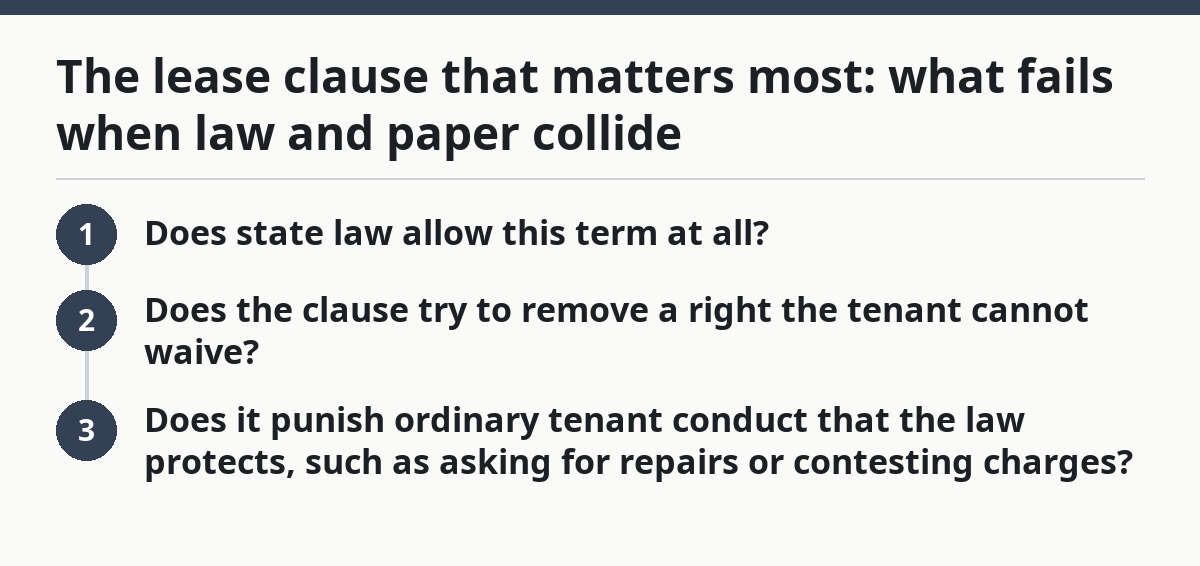
If the answer to any of those is yes, the clause may fail in whole or in part. The rest of the lease may remain in force. In many disputes, only the bad term falls away.
For a broader walkthrough of lease language before signing, the hub on lease signing and lease clauses belongs on the same shelf as this topic. The difference here is narrower: this guide focuses on the clauses that look valid on paper but often do not survive landlord-tenant law.
Which lease clauses are usually unenforceable against tenants?
The clauses most often challenged are waiver provisions, no-repair clauses, overbroad entry clauses, penalty-style late fees, and fee-shifting terms that go beyond what state law allows. Those are the common overreach points tenants miss at signing.
A useful way to spot trouble is to look for clauses that try to erase legal protections instead of allocating ordinary rental risks. The clause may be phrased as a promise, a consent, or a “condition of tenancy.” That wording does not save it if the substance is illegal.
Common examples include:
- Waiver clauses that say the tenant gives up statutory rights in advance.
- Repair responsibility clauses that shift every repair, including habitability issues, to the tenant.
- Entry clauses that let the landlord enter “at any time” or without meaningful notice.
- Late fee clauses that function as a penalty rather than a reasonable charge tied to late rent.
- Attorney fee clauses that force the tenant to pay the landlord’s legal bills no matter who wins.
- Illegal clauses tied to unlawful discrimination, self-help eviction, or retaliation.
The label on the clause matters less than its effect. A clause called “consent” can still be a waiver. A clause called “administrative fee” can still be an unlawful penalty. A clause that says the tenant is “responsible for all repairs” can still fail if state law makes the landlord responsible for the roof, heat, plumbing, or mold remediation.
The hard part is that enforceability is often partial. A court may strike the bad part and leave the rest intact. For example, a late-fee provision might be valid up to a point and invalid above it. A repair clause might be valid for minor upkeep but not for code-required repairs. That means a tenant should not assume the whole lease is useless just because one paragraph is overreaching.
A clause is also more vulnerable when it tries to defeat tenant rights that are mandatory by statute. If a state landlord-tenant act says the landlord must give notice before entry, a lease that shortens notice to zero is on thin ice. If the law gives a tenant certain defenses or remedies, a waiver clause may not erase them.
How do I spot an unenforceable clause in 10 minutes?
I can spot the likely problem in 10 minutes by checking for five red-flag phrases, then comparing them to the lease, the state law, and any local tenant rule that applies. That fast scan will not replace legal advice, but it will catch the most common overreach.
Here is a practical procedure.
- Mark any sentence with “waive,” “release,” or “agree not to sue.” Those words often signal a waiver clause, and they are the first place to check for conflict with tenant rights.
- Find every repair sentence and circle “tenant shall be responsible.” If the clause shifts structural, plumbing, electrical, heat, or other habitability repairs to the tenant, that is a red flag under many state law schemes.
- Scan the entry clause for “any time,” “without notice,” or “as needed.” A broad entry clause is often where landlords overreach on notice and access.
- Look at the late-fee paragraph for a dollar amount, a percentage, or a daily charge. If it reads like a punishment rather than a reasonable charge tied to late payment, it may be vulnerable.
- Check the attorney-fee language for one-way promises. If the lease says the tenant pays the landlord’s legal fees no matter what, that is a common overreach point, especially if state law limits fee shifting.
- Compare the clause to state law and any local housing rule. If the clause gives the landlord more power than the statute allows, the statute controls, not the lease wording.
That scan works because unenforceable lease clauses usually share one trait: they try to move legal risk off the landlord and onto the tenant without legal permission. A clean clause usually defines duties; a bad one tries to erase them.
Two sources are worth keeping close when you do this kind of reading: your state’s landlord-tenant statute and the local housing code or tenant handbook, if your city publishes one. For general federal guidance on rental housing, the Consumer Financial Protection Bureau and HUD both publish tenant-facing information that can help you spot issues, though they do not replace state law. For example, HUD’s housing discrimination guidance and the CFPB’s housing resources are useful starting points.
The biggest mistake is assuming every harsh clause is automatically void. Some are enforceable as written; some are only partly enforceable; some become relevant only after a dispute. The safer move is to flag, compare, and then get advice on the exact clause language.
Why waiver clauses are a red flag in a residential lease
Waiver clauses are usually unenforceable when they try to make a tenant give up rights the law says cannot be waived in advance. That is the most important single rule behind this topic.
A waiver clause can be broad or subtle. It may say the tenant “waives all claims,” “waives all defenses,” or “releases landlord from liability for conditions in the unit.” It may also appear in a sentence buried under “miscellaneous” terms. The wording changes; the problem stays the same.
The legal issue is not the word waiver itself. It is the attempt to erase protections that belong to the tenant by statute or public policy. A lease cannot usually eliminate the landlord’s duty to follow housing law, ignore notice requirements, or block the tenant from asserting legal defenses in court. If the clause does that, it is vulnerable.
This is where tenants get burned:
- They assume a signature equals consent.
- They think “I agreed to it” means the clause will stand.
- They ignore a one-sentence waiver because the rest of the lease looks normal.
That can be costly because a waiver clause can be used to intimidate a tenant even when it is weak. A landlord may cite it during a dispute over repairs, deposit deductions, or eviction. The tenant then feels boxed in and stops pushing back. The clause may still be unenforceable, but the pressure works.
A plain-English test helps. If the clause says the tenant must give up the right to complain, defend, or seek help when the landlord breaks the law, that clause is suspect. If it says the tenant accepts ordinary wear and tear or minor inconvenience, that may be a different matter. The legal line is usually drawn at rights the law protects regardless of contract wording.
The safe response is to cross out waiver language during review and ask whether the term is required by state law. If it is not, it should not be treated as settled just because it sits in a signed lease. If the issue is unclear, consult a tenant lawyer or legal aid office before relying on the clause. For a lot of tenants, this one paragraph is the difference between a negotiable term and a fake surrender of rights.
Repair responsibility clauses: what they can and cannot shift
Repair responsibility clauses are often unenforceable when they try to make the tenant pay for the landlord’s legal duty to maintain habitable premises. That is the clause tenants miss most often because the wording can sound ordinary.
A lease may legitimately assign minor tasks to a tenant. Changing light bulbs, replacing smoke-alarm batteries where allowed, or keeping the unit reasonably clean is common in many rentals. But a clause that shifts essential building repairs to the tenant is another matter. Roof leaks, broken heat, plumbing failures, electrical hazards, pest infestation, and code-compliance problems are usually not just “tenant chores.” They are legal maintenance issues.
The clause may use broad wording such as:
- “Tenant shall make all repairs.”
- “Tenant accepts premises in current condition.”
- “Tenant is responsible for all maintenance.”
Those phrases are dangerous because they can hide an attempt to transfer habitability obligations. In many states, the landlord’s duty to provide a safe and livable unit cannot be signed away. The lease can allocate minor upkeep, but it usually cannot erase the basic repair duty.
The practical problem is that tenants often read the clause as a total surrender. That is a mistake. The landlord may still be responsible even when the lease says otherwise. A tenant who pays for a major repair the landlord should have handled may have a claim for reimbursement or other relief, depending on state law. But getting that result may take documentation, notice, and persistence.
A tenant should save every repair notice in writing, with dates and photos, because the dispute often turns on who knew what and when. A 3-day text thread is better than memory; a certified letter can be better than a verbal complaint. The exact tool matters less than having proof.
Who this is not for: a tenant who wants certainty on a major habitability problem should not rely on the lease text alone. The enforceability of repair clauses depends heavily on state law, local housing codes, and the nature of the defect. If the issue involves heat, water, electricity, or structural damage, legal advice is usually worth getting before paying for the repair yourself.
Are late fee and attorney fee clauses always enforceable?
No, late fee and attorney fee clauses are not always enforceable, and they are often narrowed by state law even when the lease looks clear. That is where many tenants overpay or give up too soon.
Late fee clauses can fail for a few reasons. The fee may be treated as an unlawful penalty if it is not tied to a real estimate of the landlord’s loss from late payment. The lease may also impose a charge that state law caps or forbids. Some leases add a daily fee after the first late charge, which can turn a modest charge into a compounding burden very quickly. Even if the clause is not fully void, a court may limit it. If the fee structure looks punitive, consult a local housing lawyer or legal aid office.
Attorney fee clauses have a similar problem. A lease may say the tenant must pay the landlord’s attorney fees in any dispute. That sounds simple, but many states limit one-way fee shifting or require a prevailing-party rule. A clause that automatically gives the landlord fees no matter who wins may be unenforceable, or only partly enforceable, depending on state law.
The same caution applies to collection language that adds “all costs,” “all expenses,” or “all fees” without limit. Those words can be used to stack charges in ways the law does not permit. A lease that turns a late rent balance into a pile of fees, service charges, and legal costs is worth a hard second look.
The mistake tenants make is waiting until a dispute starts. By then, the landlord may have already quoted the clause as if it were settled law. The better move is to identify the fee structure while the relationship is still calm, especially if the lease uses a daily late fee, a percentage fee, or one-sided legal-cost language.
A practical rule is simple: if the clause reads like it was written to punish delay or deter a tenant from fighting back, it deserves scrutiny under state law. A penalty is not the same thing as a reasonable fee.
Entry clauses and other overreach: what landlords cannot write around
Entry clauses are often unenforceable when they allow unlimited access, skip notice, or hand the landlord a blank check to enter the unit. That is one of the clearest examples of a clause that looks neat on paper but breaks down under tenant-rights law.
A lawful entry clause usually needs boundaries. Those boundaries often involve notice, a legitimate reason, and a limited time window.
Drafted with AI; not yet reviewed by a person.